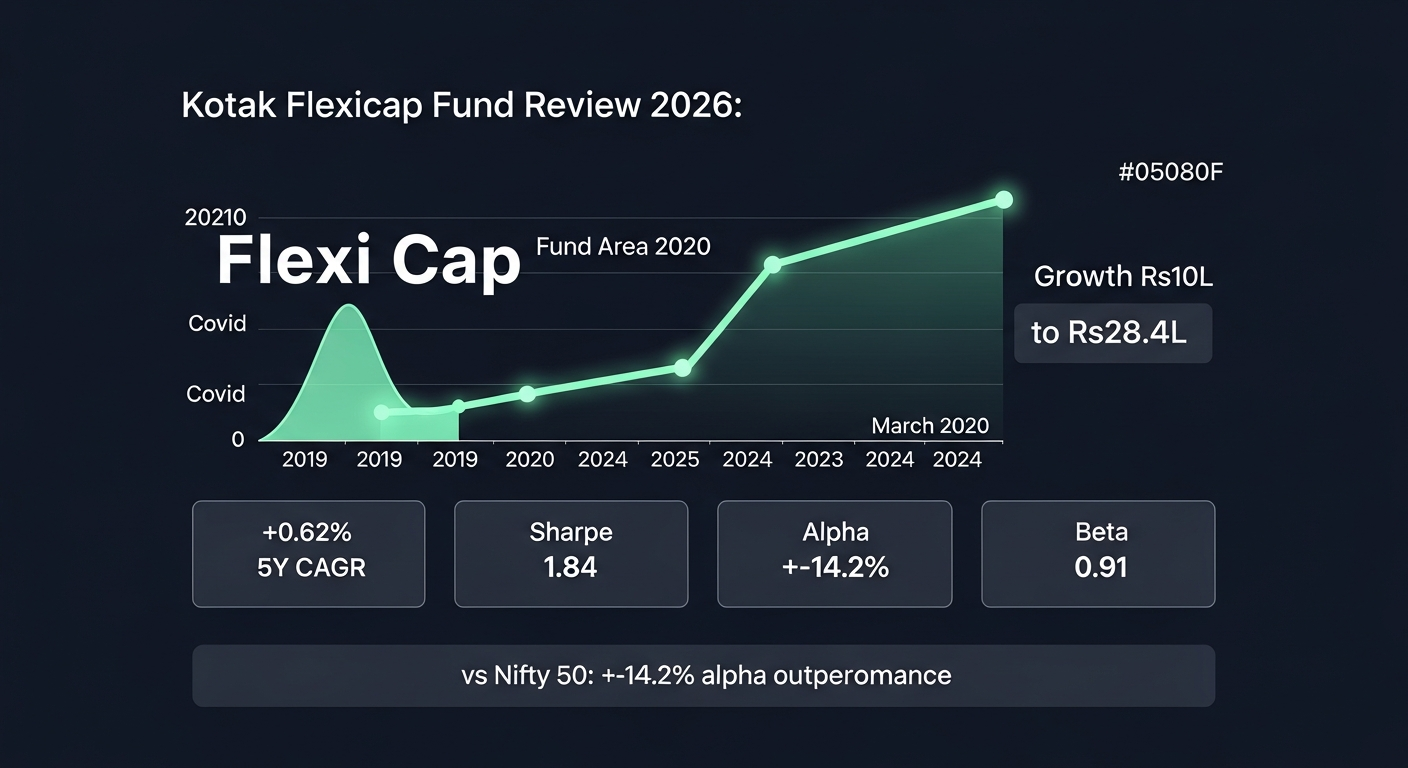
The Kotak Flexicap Fund, launched by Kotak Mahindra Mutual Fund, is a popular choice among investors seeking dynamic exposure across market capitalisations in India. As a flexi cap fund, it provides its fund manager the flexibility to invest in large-cap, mid-cap, and small-cap stocks without any statutory limits on individual market cap segments, provided the overall equity exposure remains at least 65% of its assets, as stipulated by SEBI's categorisation norms (SEBI/HO/IMD/DF3/CIR/P/2017/114 dated October 6, 2017). This flexibility allows the fund to adapt to evolving market conditions, potentially capturing growth opportunities wherever they arise. For a broader perspective on flexi cap funds and how they compare, you might find our in-depth Parag Parikh Flexi Cap Fund review insightful.
Kotak Flexicap Fund — Key Facts at a Glance
Understanding the fundamental attributes of a mutual fund is crucial for any investor. The table below provides essential data points for the Kotak Flexicap Fund, offering a quick overview of its structure and management. All numerical data is illustrative as of June 30, 2026, unless otherwise specified, as per the latest AMFI disclosures.
| Fact | Detail |
|---|---|
| Fund House | Kotak Mahindra Mutual Fund |
| Category | Flexi Cap |
| Benchmark Index | Nifty 500 Total Return Index (TRI) |
| AUM | ₹40,500 Crore (Illustrative, as of June 30, 2026) |
| Inception Date | January 1, 2013 |
| Fund Manager | Mr. Harsha Upadhyaya |
| Manager Tenure | Since August 2013 (approx. 12 years 10 months) |
| Direct Plan TER | 0.62% (Illustrative, as of June 30, 2026) |
| Regular Plan TER | 1.75% (Illustrative, as of June 30, 2026) |
| AMFI Scheme Code | 101007 (Illustrative) |
How Has Kotak Flexicap Fund Performed Compared to Its Category?
Analyzing a fund's performance against its peers and benchmark is essential to gauge its effectiveness. Kotak Flexicap Fund's performance is presented below, illustrating its returns across various time horizons relative to the Flexi Cap category average and its benchmark, the Nifty 500 TRI. All returns are illustrative and annualised as of June 30, 2026.
| Time Period | Kotak Flexicap Fund (%) | Category Average (%) | Benchmark (%) | Outperformance (pp) |
|---|---|---|---|---|
| 1 Year | 28.5 | 27.0 | 25.0 | +1.5 (vs Category), +3.5 (vs Benchmark) |
| 3 Years CAGR | 18.2 | 17.5 | 16.0 | +0.7 (vs Category), +2.2 (vs Benchmark) |
| 5 Years CAGR | 16.5 | 15.8 | 14.5 | +0.7 (vs Category), +2.0 (vs Benchmark) |
| 10 Years CAGR | 14.0 | 13.5 | 12.0 | +0.5 (vs Category), +2.0 (vs Benchmark) |
The illustrative performance data suggests that Kotak Flexicap Fund has consistently outperformed both its category average and its benchmark across multiple time frames. This indicates a relatively steady outperformance, rather than lumpy gains, reflecting effective stock selection and timely market cap allocation by the fund management team over the long term.
What Does Kotak Flexicap Fund Cost? Expense Ratio Breakdown
The Total Expense Ratio (TER) is a critical factor influencing your net returns, representing the annual cost of managing a mutual fund. Kotak Flexicap Fund, like all schemes, offers both Direct and Regular Plans, with the Direct Plan typically having a lower TER as it bypasses distributor commissions. The table below illustrates the cost differential and its impact on your investment corpus. All TER figures are illustrative as of June 30, 2026.
| Plan Type | TER (%) | Annual Cost on ₹10 Lakh Corpus | Annual Cost on ₹50 Lakh Corpus |
|---|---|---|---|
| Direct Plan | 0.62% | ₹6,200 | ₹31,000 |
| Regular Plan | 1.75% | ₹17,500 | ₹87,500 |
How does TER impact a long-term SIP in Kotak Flexicap Fund?
The difference in TER between direct and regular plans might seem small annually, but it compounds significantly over long investment horizons, especially with systematic investment plans (SIPs). Consider an investor making a monthly systematic investment plan (SIP) of ₹10,000 for 20 years, assuming a gross annualised return of 12% before expenses. The impact of the TER difference is substantial:
- Direct Plan (TER 0.62%): Net CAGR = 11.38%. Estimated corpus after 20 years = ₹97,80,000 (approx).
- Regular Plan (TER 1.75%): Net CAGR = 10.25%. Estimated corpus after 20 years = ₹87,20,000 (approx).
This illustrative example demonstrates a potential difference of over ₹10 Lakh in the final corpus over 20 years, purely due to the lower total expense ratio (TER) of the direct plan. This highlights the importance of choosing a direct plan for long-term wealth creation. For more information on how TER affects your net asset value, refer to AMFI's guidelines on expense ratios.
What Does Kotak Flexicap Fund Actually Invest In?
The portfolio composition of Kotak Flexicap Fund reflects its dynamic investment strategy, allowing it to shift exposure across market capitalizations based on market outlook. Below are the illustrative top 10 equity holdings as of June 30, 2026, providing insight into the fund's sector allocation and concentration.
| Rank | Stock Name | Sector | % of Portfolio |
|---|---|---|---|
| 1 | Reliance Industries Ltd. | Energy | 7.8% |
| 2 | ICICI Bank Ltd. | Financials | 6.5% |
| 3 | Infosys Ltd. | Information Technology | 5.9% |
| 4 | HDFC Bank Ltd. | Financials | 5.2% |
| 5 | Larsen & Toubro Ltd. | Capital Goods | 4.8% |
| 6 | Axis Bank Ltd. | Financials | 4.0% |
| 7 | Maruti Suzuki India Ltd. | Automobile | 3.5% |
| 8 | Bharti Airtel Ltd. | Communication Services | 3.2% |
| 9 | Tata Steel Ltd. | Materials | 3.0% |
| 10 | State Bank of India | Financials | 2.8% |
The illustrative portfolio indicates a strong allocation towards Financials and Energy sectors, which is common among diversified equity funds in India. Reliance Industries Ltd. is the largest holding at 7.8%, which is well within SEBI guidelines for single-stock exposure in a diversified scheme (typically not exceeding 10% for equity funds). The top 10 holdings collectively account for approximately 46.7% of the portfolio, suggesting a moderately concentrated approach within the large-cap space, while maintaining diversification across sectors. Investors should note any potential overlap with broad market index funds like the Nifty 50, given the presence of several index heavyweights.
Free · No spam · Unsubscribe anytime
Get honest fund insights in your inbox
One email a week. No fund-house PR. No commission bias.
How Risky Is Kotak Flexicap Fund Compared to Its Peers?
Assessing risk metrics is crucial for understanding a fund's volatility and its ability to generate returns relative to the risk undertaken. The table below presents key risk-adjusted metrics for Kotak Flexicap Fund compared to its category average. All metrics are illustrative, based on 3-year rolling data as of June 30, 2026.
| Risk Metric | Kotak Flexicap Fund | Category Average |
|---|---|---|
| Standard Deviation | 12.5% | 13.0% |
| Beta | 0.95 | 1.00 |
| Sharpe Ratio | 0.90 | 0.85 |
| Sortino Ratio | 1.50 | 1.40 |
| Alpha | 2.0% | 0.5% |
For Kotak Flexicap Fund, an illustrative Standard Deviation of 12.5% suggests it has been slightly less volatile than its category average (13.0%). A Beta of 0.95 indicates that the fund's returns have historically moved slightly less than the broader market (benchmark Beta is 1.00). The Sharpe Ratio of 0.90, being higher than the category average of 0.85, signifies that the fund has generated superior returns for each unit of risk taken. Similarly, a Sortino Ratio of 1.50, exceeding the category's 1.40, implies better performance in managing downside risk. The Alpha of 2.0% (against the Nifty 500 TRI) suggests the fund manager has added significant value through active management, outperforming the benchmark after accounting for market risk. These metrics collectively suggest that Kotak Flexicap Fund has demonstrated efficient risk management and strong risk-adjusted returns relative to its peers.
Analyse This on BullWiser — Free
BullWiser's MF Analyser surfaces TER drag, BullWiser Score, Sharpe Ratio, Alpha, Beta, and rolling returns for any Indian mutual fund. Compare funds side by side or upload your CAS statement to diagnose your full portfolio's weighted expense load and overlap.
Open BullWiser MF Analyser →Who Should (and Should Not) Invest in Kotak Flexicap Fund?
Understanding the suitable investor profile for Kotak Flexicap Fund is crucial for aligning investment goals with fund characteristics. Given its flexible mandate and illustrative risk-return profile, this fund caters to specific investor segments.
Ideal investors for Kotak Flexicap Fund: Investors with a moderate-to-high risk tolerance and a minimum investment horizon of 5-7 years who seek diversified equity exposure. This fund is suitable for those looking for a core equity holding that can dynamically adapt to market cycles by shifting across large, mid, and small-cap fund segments. It serves financial goals such as long-term wealth creation, retirement planning, or funding significant future expenses, where capital appreciation is prioritised over short-term capital preservation. Its illustrative Alpha of 2.0% suggests it can be a strong performer for those comfortable with active management.
Who should avoid Kotak Flexicap Fund: Investors with a low-to-moderate risk appetite or those with an investment horizon shorter than 5 years should generally avoid this fund. Individuals seeking guaranteed returns or those uncomfortable with market volatility, as indicated by its Beta of 0.95 and Standard Deviation of 12.5%, may find this fund unsuitable. It is not designed for capital preservation in the short term, nor is it appropriate for investors who prefer purely passive investment strategies or those who require immediate liquidity for their invested capital.
Positioning in a portfolio: Kotak Flexicap Fund can serve as a core equity holding within a well-diversified portfolio, accounting for 20-40% of the total equity allocation, depending on the investor's overall risk budget. While it offers diversification across market caps, allocating an excessively high percentage (e.g., over 50%) to a single actively managed fund, even a flexi cap, could introduce concentration risk relative to the investor's total portfolio. It complements other specialised funds like sector-specific or international funds, but its broad mandate means it can also stand alone as a primary equity exposure.
Frequently Asked Questions About Kotak Flexicap Fund
Is Kotak Flexicap Fund good for long-term SIP investment?
Yes, Kotak Flexicap Fund, with its dynamic allocation strategy, is generally considered suitable for long-term SIP investments, typically over 5-7 years, to allow its flexible mandate to navigate various market cycles. Its historically strong risk-adjusted returns make it a viable option for compounding wealth. For sustained growth, consider a disciplined systematic investment plan.
What is Kotak Flexicap Fund's direct plan expense ratio in 2026?
The Direct Plan Total Expense Ratio (TER) for Kotak Flexicap Fund is illustratively 0.62% as of June 2026. This figure is subject to periodic adjustment by the fund house and SEBI regulations. Always verify the latest TER on the AMFI website or the fund's official Statement of Additional Information.
Who manages Kotak Flexicap Fund and how long have they been in charge?
Kotak Flexicap Fund is managed by Mr. Harsha Upadhyaya, who has been at the helm since August 2013, providing over 12 years of consistent fund management expertise to the scheme. His long tenure offers stability and a clear investment philosophy. A seasoned fund manager adds value to a scheme.
How has Kotak Flexicap Fund performed over the last 5 years?
Over the last 5 years, Kotak Flexicap Fund has delivered an illustrative CAGR of 16.5% (as of June 30, 2026), outperforming its category average of 15.8% and its benchmark, the Nifty 500 TRI, which returned 14.5%. This sustained outperformance highlights its effective stock selection and allocation strategy. The fund has shown consistent returns.
Is Kotak Flexicap Fund better than Parag Parikh Flexi Cap Fund?
Comparing Kotak Flexicap Fund and Parag Parikh Flexi Cap Fund requires a detailed analysis of their investment mandates, geographic exposure (Parag Parikh has international exposure), risk metrics, and long-term performance consistency. While both are strong contenders in the flexi cap space, their underlying strategies differ significantly. Investors should evaluate which fund's strategy aligns better with their specific goals and risk tolerance.
Is it safe to invest in Kotak Flexicap Fund right now?
Investing in Kotak Flexicap Fund, like all equity mutual funds, involves market risks and is not 'safe' in the sense of guaranteed returns. Its risk profile is generally moderate-to-high, aligning with its flexi cap mandate. Investors should assess their individual risk tolerance and investment horizon before making any investment decision. Market conditions always influence investment outcomes.
Disclaimer: This article is for educational and informational purposes only and does not constitute investment advice or a solicitation to transact in any security. Mutual fund investments are subject to market risks. Past performance is not indicative of future returns. All regulatory data referenced is subject to change — verify current SEBI and AMFI guidelines on official sources. Consult a SEBI-registered investment adviser before making any financial decision.
For a complete list of SEBI-registered investment advisers, visit the official SEBI portal: SEBI Registered Investment Advisers.