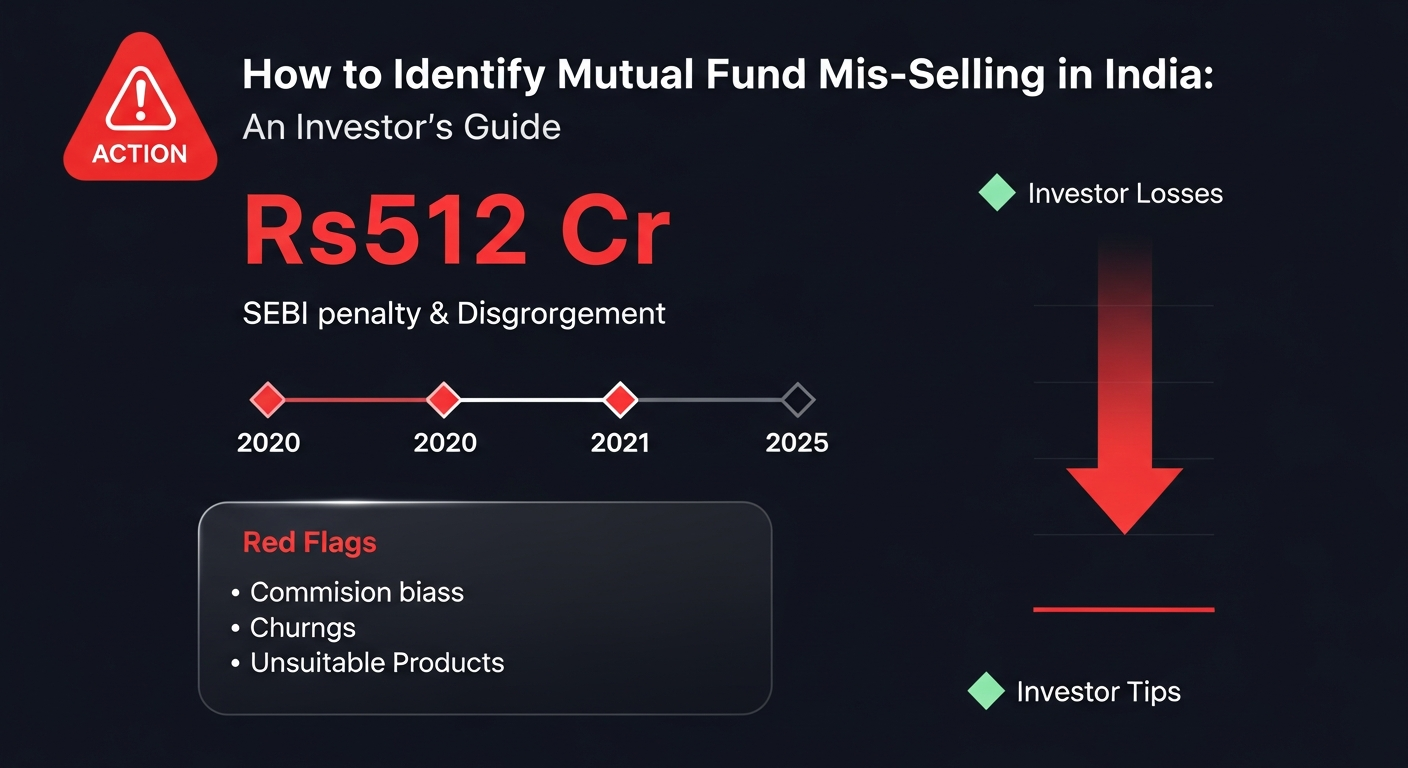
What Is Mutual Fund Mis-Selling in India?
Mutual fund mis-selling in India occurs when an investment adviser or distributor provides misleading information, makes unsuitable recommendations, or fails to disclose material facts, leading an investor to make an investment decision inconsistent with their financial goals or risk profile. SEBI circular SEBI/HO/IMD/DF1/CIR/P/2019/169 dated December 24, 2019, outlines the obligations of intermediaries to ensure suitability of recommendations. Understanding mis-selling's regulatory framework is crucial for investor protection.
This often manifests as recommending a regular plan when a direct plan is available with identical underlying assets but a significantly lower total expense ratio (TER), or steering a conservative investor towards high-risk small cap fund without proper disclosure. The core issue is a misalignment between the investor's best interest and the advice provided, often driven by commission incentives.
How to Identify Mutual Fund Mis-Selling: A Step-by-Step Guide
Identifying mutual fund mis-selling requires a systematic approach to scrutinise the advice received and the recommended products against your personal financial situation and regulatory guidelines. The following steps outline how to conduct this due diligence effectively.
Step 1: Verify Direct vs. Regular Plan TER
Always compare the Total Expense Ratio (TER) of the recommended regular plan with its direct plan counterpart. Distributors earn commissions from regular plans, which results in a higher TER for the investor, typically 0.50% to 1.10% higher than direct plans, as per AMFI data for various categories. This difference directly impacts your net returns over the long term, constituting a significant cost drag.
Step 2: Cross-Reference Fund Category and Investment Objective
Confirm that the recommended fund's SEBI-defined category and stated investment objective align with your documented financial goals and risk appetite. For instance, if you have a short-term goal (under 3 years) and low risk tolerance, a recommendation for an equity-oriented fund (e.g., a small cap fund) would be a mismatch. SEBI's categorisation circular SEBI/HO/IMD/DF3/CIR/P/2017/114 dated October 06, 2017, clearly defines fund categories, making this verification straightforward.
Step 3: Assess Risk Profile Alignment (KYC and Fund Metrics)
Evaluate if the fund's inherent risk profile, as indicated by metrics like Standard Deviation, Beta, and Sharpe Ratio, matches your documented investor risk assessment (KYC). A distributor is mandated to assess your risk profile. Recommending a fund with a high Beta (e.g., >1.0, indicating higher volatility than the market) to a moderate or conservative investor, or a fund with a high Standard Deviation without a clear explanation of associated risks, suggests potential mis-selling.
Step 4: Scrutinise Exit Loads and Lock-in Periods
Check for any undisclosed exit loads or lock-in periods that may restrict your liquidity. Most equity funds impose an exit load (typically 1% if redeemed within 1 year), while schemes like ELSS have a mandatory 3-year lock-in period. Failure to explicitly inform an investor about these charges or liquidity constraints, especially for those with immediate capital needs, can be a sign of mis-selling.
Step 5: Demand All Disclosure Documents (KIM, SID, SAI)
Insist on receiving and thoroughly reviewing the Key Information Memorandum (KIM), Scheme Information Document (SID), and Statement of Additional Information (SAI) before making any investment. These regulatory documents contain all essential details about the fund, including its investment strategy, risks, expenses, and past performance. A distributor's reluctance or refusal to provide these is a significant red flag.
Worked Example: Diagnosing Potential Mis-Selling Scenarios
Understanding the practical application of these steps is crucial. Let's consider two illustrative scenarios to highlight how mis-selling can be identified using BullWiser's analytical framework.
Scenario 1: The Undisclosed TER Discrepancy
An investor, Ms. Priya (age 35, moderate risk tolerance), approaches a distributor seeking to invest in a diversified equity fund for her retirement, 25 years away. The distributor recommends the "Parag Parikh Flexi Cap Fund - Regular Plan" without mentioning the direct plan alternative. Let's assume illustrative TERs for this example:
| Fund Plan | Illustrative TER (as of FY 2023-24) |
|---|---|
| Parag Parikh Flexi Cap Fund - Regular Plan | 1.50% |
| Parag Parikh Flexi Cap Fund - Direct Plan | 0.70% |
Ms. Priya decides to invest Rs. 10,000 per month via a systematic investment plan (SIP) for 25 years, assuming a gross annual return of 12% before TER. The impact of the TER difference is substantial:
| Metric | Regular Plan | Direct Plan |
|---|---|---|
| Gross CAGR (before TER) | 12.00% | 12.00% |
| Applied TER | 1.50% | 0.70% |
| Net CAGR (after TER) | 10.50% | 11.30% |
| Monthly SIP | ₹10,000 | ₹10,000 |
| Investment Period | 25 years | 25 years |
| Total Investment | ₹30,00,000 | ₹30,00,000 |
| Projected Corpus (after 25 years) | ₹1,47,40,000 | ₹1,84,30,000 |
| Corpus Difference | ₹36,90,000 (Lower for Regular Plan) | |
Diagnosis: The distributor's failure to disclose the direct plan option and its significant cost advantage, leading to a projected corpus difference of nearly ₹37 lakhs over 25 years, is a strong indicator of potential mis-selling. The recommendation prioritised distributor commission over Ms. Priya's long-term wealth maximisation.
Scenario 2: Risk Profile Mismatch for a Conservative Investor
Mr. Sameer (age 60, retired, very low risk tolerance) seeks to invest a lumpsum of Rs. 20 lakhs for supplementary income and capital preservation over 5 years. His risk profile assessment clearly indicates a preference for capital protection and minimal volatility. The distributor recommends the "HDFC Small Cap Fund - Regular Plan".
| Risk Metric | HDFC Small Cap Fund (Illustrative, as of FY 2023-24) | Typical Ultra-Conservative Debt Fund |
|---|---|---|
| Standard Deviation | 18-22% | 1-3% |
| Beta | 1.05-1.15 | Not applicable (equity-linked) |
| Sharpe Ratio | 0.8-1.2 | 0.2-0.5 |
Diagnosis: Recommending a small cap fund, known for its high volatility (Standard Deviation 18-22%) and higher market sensitivity (Beta > 1), to a retired investor with very low risk tolerance and a short-to-medium time horizon (5 years) is a clear case of mis-selling. The fund's objective of high growth from small companies fundamentally conflicts with Mr. Sameer's goal of capital preservation and stable income. This mismatch directly violates the suitability requirements outlined in SEBI guidelines.
Free · No spam · Unsubscribe anytime
Learn investing without the jargon
Plain-English guides on MFs, SIPs, and taxes — one email a week, free forever.
Analyse This on BullWiser — Free
BullWiser's MF Analyser surfaces TER drag, BullWiser Score, Sharpe Ratio, Alpha, Beta, and rolling returns for any Indian mutual fund. Compare funds side by side or upload your CAS statement to diagnose your full portfolio's weighted expense load and overlap.
Open BullWiser MF Analyser →Common Misconceptions About Identifying Mis-Selling
Several common beliefs can hinder an investor's ability to identify genuine instances of mutual fund mis-selling. Dispelling these myths with data and regulatory context is crucial for informed decision-making.
Is a high commission always mis-selling?
No, a high commission itself is not synonymous with mis-selling, but it often creates a conflict of interest that can lead to it. Distributors receive commissions from asset management companies (AMCs) for selling regular plans, which are embedded within the fund's Total Expense Ratio (TER). This incentive structure means a distributor benefits more from selling a regular plan than a direct plan, which carries no distributor commission. Mis-selling occurs when this commission motive overrides the investor's suitability and the direct plan alternative is not disclosed, or an unsuitable fund is recommended solely for higher commission.
Can I rely solely on past returns to detect mis-selling?
Relying solely on past returns is insufficient to detect mis-selling and can be highly misleading. Past performance is not indicative of future returns, as stipulated in all mutual fund offer documents. A distributor might showcase a fund with stellar past returns (e.g., 25% CAGR over 3 years), but if that fund's risk profile (high Standard Deviation, Beta) is completely misaligned with the investor's low risk tolerance or short investment horizon, it constitutes mis-selling. The focus must always be on suitability and the fund's objective matching the investor's profile, rather than merely chasing historical returns.
Frequently Asked Questions About Identifying Mutual Fund Mis-Selling
What is the primary indicator of mutual fund mis-selling?
The primary indicator of mutual fund mis-selling is a recommendation that does not align with your financial goals, risk tolerance, or time horizon. Often, this involves pushing regular plans over direct plans without adequate disclosure of higher costs. You should always ensure the fund suits your profile.
Can I switch from a regular plan to a direct plan if I suspect mis-selling?
Yes, investors can typically switch from a regular plan to a direct plan of the same scheme. This process involves redeeming units from the regular plan and reinvesting in the direct plan. Be mindful of potential exit loads and capital gains tax implications during this switch. It's a common way to reduce costs.
How does SEBI define mis-selling in mutual funds?
SEBI defines mis-selling as any act or omission by an intermediary that leads to an investor making an unsuitable investment decision. This includes providing misleading information, recommending products that don't match the investor's profile, or failing to disclose material facts. SEBI aims to protect investors from such practices.
What documents should I always ask for before investing in a mutual fund?
Before investing, you should always ask for the Key Information Memorandum (KIM), Scheme Information Document (SID), and Statement of Additional Information (SAI). These documents provide critical details about the fund's objectives, risks, charges, and past performance. Reviewing these is crucial for informed decisions.
Is a high commission always a sign of mis-selling?
A high commission itself isn't automatically mis-selling, but it can be a red flag. Distributors earn commissions from regular plans, which incentivises recommending them over direct plans. The key is whether the recommended fund genuinely suits your profile despite the commission structure. Always prioritise suitability over commission structures.
What should I do if I believe I have been a victim of mis-selling?
If you believe you've been a victim of mis-selling, first contact the fund house and the distributor in writing to document your complaint. If unresolved, you can escalate the matter to SEBI through their SCORES portal. Document all communications carefully. This platform helps resolve investor grievances.
Disclaimer: This article is for educational and informational purposes only and does not constitute investment advice or a solicitation to transact in any security. Mutual fund investments are subject to market risks. Past performance is not indicative of future returns. All regulatory data referenced is subject to change — verify current SEBI and AMFI guidelines on official sources. Consult a SEBI-registered investment adviser before making any financial decision.
For a complete list of SEBI-registered investment advisers, visit the official SEBI portal: SEBI Registered Investment Advisers.