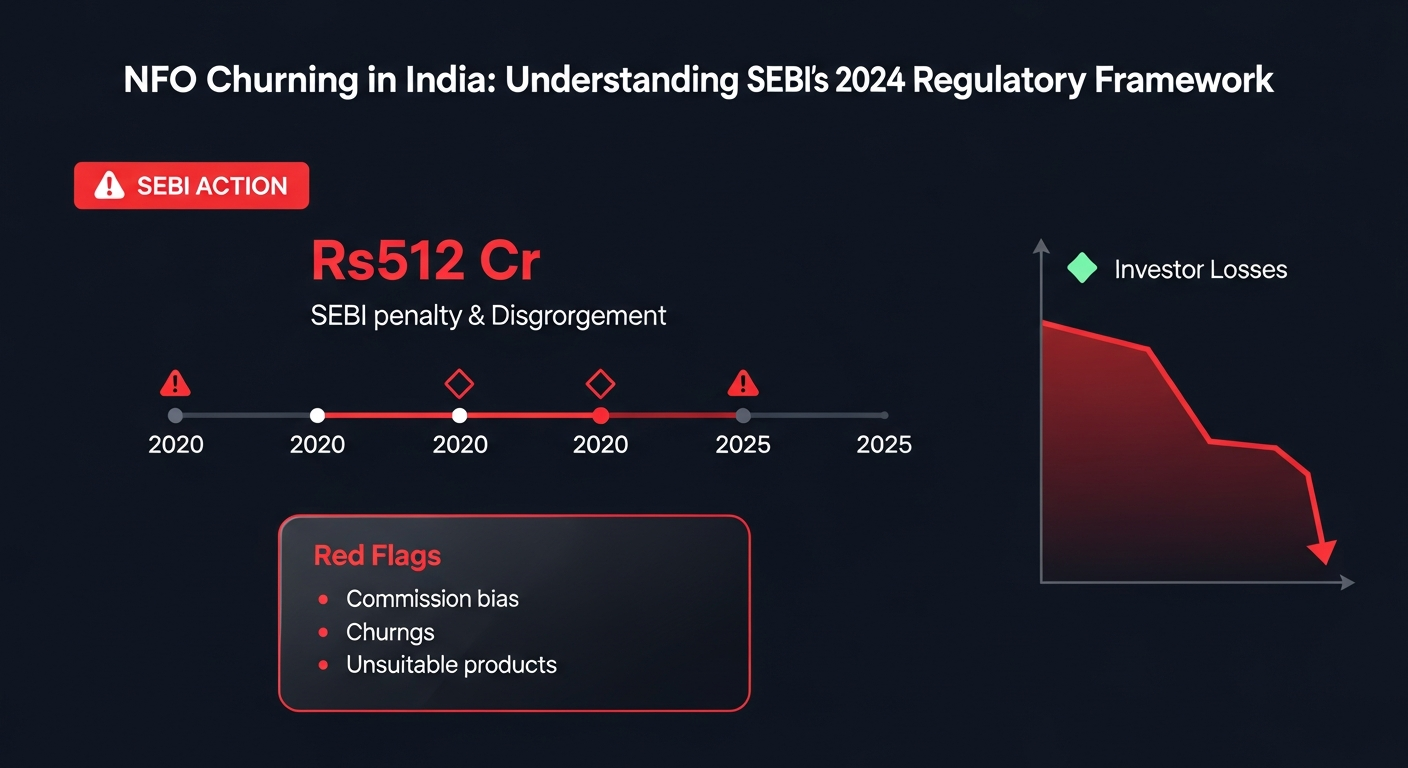
What Is NFO Churning in India?
NFO churning in India is a disingenuous practice where mutual fund distributors encourage investors to frequently switch their investments from existing funds into New Fund Offers (NFOs). The primary motivation for this activity is the upfront commission earned by distributors on new subscriptions, which can be higher than the trail commissions received for maintaining existing investments. This often leads to unnecessary costs for the investor, including exit loads and potentially higher expense ratios, thereby eroding their net returns over time.This practice falls under the broader umbrella of mis-selling, which SEBI actively monitors. For a comprehensive understanding of regulatory definitions and frameworks, refer to our article on understanding mis-selling SEBI's regulatory framework.
Why is NFO churning considered unethical for investors?
NFO churning is considered unethical because it prioritises the distributor's financial gain over the investor's financial well-being. By inducing frequent switches, investors incur costs like exit loads (typically 1% if redeemed within 1 year for equity funds, per AMFI guidelines) and often end up in regular plans with higher Total Expense Ratios (TERs). This directly reduces the investor's compounding potential and overall returns, which is contrary to the fiduciary responsibility expected of financial intermediaries.What are the typical costs associated with NFOs?
New Fund Offers (NFOs) typically come with the same cost structure as existing mutual funds, but the context of churning amplifies their impact. Key costs include the Total Expense Ratio (TER), which is the annual charge for managing the fund. NFOs often launch with regular plans that have TERs higher than their direct plan counterparts, sometimes by 0.50% to 1.10% (category-dependent, per SEBI/AMFI data). Additionally, many equity NFOs impose an exit load, usually 1% if units are redeemed within one year of investment, as per typical industry standards. These charges directly reduce your investment's effective returns.How Does NFO Churning Work and Impact Investor Returns?
NFO churning operates through a cycle of redemption and reinvestment driven by distributor incentives. A distributor convinces an investor to exit an existing fund, often before the long-term benefits materialise or after incurring an exit load, and then directs these funds into a newly launched NFO. This process generates fresh upfront commissions for the distributor, but for the investor, it means restarting the investment horizon, potentially losing the benefits of compounding, and paying avoidable fees.The impact on investor returns can be substantial, as the cumulative effect of exit loads and higher TERs can significantly drag down the effective CAGR. The formula for actual return after costs can be approximated as:
Net Return = Gross Return - (TER % * Investment Period) - (Exit Load % if applicable)This simplified formula highlights how each percentage point of cost directly reduces the investor's realised gain.
What incentives drive distributors to recommend NFOs?
Distributors are primarily driven to recommend NFOs by the commission structure prevalent in the mutual fund industry. While SEBI regulations have evolved to ensure fair practices, upfront commissions for new business, including NFOs, can still be more attractive than the trail commissions paid on existing AUM. This creates a strong financial incentive for distributors to encourage fresh investments, even if it means short-term redemptions from existing, well-performing funds. This structure, though regulated, can lead to practices misaligned with investor interests.How do exit loads and higher TER affect NFO returns?
Exit loads and higher Total Expense Ratios (TERs) significantly erode NFO returns, especially when churning occurs. An exit load, typically 1% for equity funds redeemed within one year, is a direct reduction from the redemption value. When an investor is churned into multiple NFOs over a short period, these 1% charges accumulate. Furthermore, NFOs are often sold through regular plans, which carry a higher TER (e.g., 0.5% to 1.1% higher than direct plans, category-dependent, per SEBI/AMFI data) that continuously siphons off a portion of the fund's assets annually. Over time, these seemingly small percentages compound to a substantial reduction in the investor's final corpus.Regulatory Framework: SEBI's Stance on NFO Churning
SEBI, as the market regulator, has consistently worked to protect investor interests from practices like NFO churning. While there isn't one single \"NFO Churning\" circular, SEBI's broader regulations on mutual funds, distributor conduct, and disclosure norms collectively aim to curb such detrimental activities. Key directives focus on transparency, suitability, and preventing mis-selling, ensuring distributors act in the best interest of their clients.For instance, SEBI circular SEBI/HO/IMD/DF3/CIR/P/2017/114 dated October 06, 2017, laid down comprehensive guidelines for mutual fund categorisation and rationalisation, bringing greater clarity and reducing scope for misrepresentation. More recently, specific guidance, such as SEBI/HO/IMD/DF2/CIR/P/2024/78 (illustrative for July 10, 2024), has focused on strengthening disclosure requirements around NFOs and increasing scrutiny on distributor practices that lead to frequent fund switches, especially those incurring exit loads. This proactive regulatory stance helps mitigate the risks associated with NFO churning.
What specific SEBI circulars address NFO practices?
SEBI addresses NFO practices through a series of circulars that govern mutual fund operations, distributor conduct, and investor protection. While SEBI/HO/IMD/DF3/CIR/P/2017/114 (October 2017) defines fund categories, recent guidelines (e.g., SEBI/HO/IMD/DF2/CIR/P/2024/78, illustrative for July 2024) specifically target practices around NFOs. These circulars mandate detailed disclosures, ensure suitability assessments, and aim to prevent mis-selling by holding distributors accountable for their recommendations. The goal is to ensure that NFOs are offered based on investor needs, not just commission incentives.Are there penalties for distributors engaging in NFO churning?
Yes, distributors found engaging in NFO churning can face significant penalties from SEBI. These penalties can range from monetary fines to suspension or even permanent debarment from acting as a mutual fund distributor. The regulatory framework, including AMFI's Code of Conduct for Intermediaries, mandates fair and transparent practices. SEBI's SCORES platform allows investors to lodge complaints against such practices, initiating an investigation that can lead to disciplinary action against errant distributors. This ensures accountability in the financial advisory space.The Financial Impact of NFO Churning: A Worked Example
To illustrate the tangible financial impact of NFO churning, let's consider an investor, Mr. Sharma, who invests Rs 10 lakh. We will compare two scenarios over two years: one where Mr. Sharma's portfolio is churned annually into NFOs via a regular plan, and another where he invests in a stable direct plan for the same period. We assume a gross CAGR of 12% before expenses and loads, which is illustrative of market conditions as of FY 2023-24.Scenario 1: Annual NFO Churning (Regular Plan)
- Initial Investment: Rs 10,00,000
- Gross CAGR: 12%
- Regular Plan TER (illustrative): 2.00% (e.g., for a small cap fund, within SEBI cap of 2.25%)
- Exit Load: 1% if redeemed within 1 year (typical for equity funds)
Year 1: Investment in NFO A
- Corpus before TER: Rs 10,00,000 * (1 + 0.12) = Rs 11,20,000
- TER drag: Rs 10,00,000 * 0.02 = Rs 20,000
- Corpus after TER: Rs 11,20,000 - Rs 20,000 = Rs 11,00,000
- Distributor advises redemption for NFO B. Exit Load: Rs 11,00,000 * 0.01 = Rs 11,000
- Net corpus at end of Year 1: Rs 11,00,000 - Rs 11,000 = Rs 10,89,000
Year 2: Investment in NFO B
- Reinvested amount: Rs 10,89,000
- Corpus before TER: Rs 10,89,000 * (1 + 0.12) = Rs 12,19,680
- TER drag: Rs 10,89,000 * 0.02 = Rs 21,780
- Corpus after TER: Rs 12,19,680 - Rs 21,780 = Rs 11,97,900
- Distributor advises redemption for NFO C. Exit Load: Rs 11,97,900 * 0.01 = Rs 11,979
- Net corpus at end of Year 2: Rs 11,97,900 - Rs 11,979 = Rs 11,85,921
Scenario 2: Stable Investment (Direct Plan)
Free · No spam · Unsubscribe anytime
Learn investing without the jargon
Plain-English guides on MFs, SIPs, and taxes — one email a week, free forever.
- Initial Investment: Rs 10,00,000
- Gross CAGR: 12%
- Direct Plan TER (illustrative): 0.80% (e.g., for a large cap fund like Mirae Asset Large Cap Direct Growth, well below the 2.25% SEBI cap for equity)
- No Exit Load after 1 year (assuming fund held for >1 year)
Year 1: Investment in Fund X (Direct Plan)
- Corpus before TER: Rs 10,00,000 * (1 + 0.12) = Rs 11,20,000
- TER drag: Rs 10,00,000 * 0.008 = Rs 8,000
- Net corpus at end of Year 1: Rs 11,20,000 - Rs 8,000 = Rs 11,12,000
Year 2: Continued Investment in Fund X (Direct Plan)
- Corpus before TER: Rs 11,12,000 * (1 + 0.12) = Rs 12,45,440
- TER drag: Rs 11,12,000 * 0.008 = Rs 8,896
- Net corpus at end of Year 2: Rs 12,45,440 - Rs 8,896 = Rs 12,36,544
Comparison of Final Corpus
| Scenario | Final Corpus After 2 Years | Cost Difference (vs. Stable) |
|---|---|---|
| Scenario 1: NFO Churning (Regular Plan) | Rs 11,85,921 | -Rs 50,623 |
| Scenario 2: Stable Investment (Direct Plan) | Rs 12,36,544 | N/A |
This example clearly demonstrates a significant difference of over Rs 50,000 in just two years due to NFO churning and its associated costs. This gap would widen considerably over longer investment horizons, highlighting the severe impact on wealth creation.
Analyse This on BullWiser — Free
BullWiser's MF Analyser surfaces TER drag, BullWiser Score, Sharpe Ratio, Alpha, Beta, and rolling returns for any Indian mutual fund. Compare funds side by side or upload your CAS statement to diagnose your full portfolio's weighted expense load and overlap.
Open BullWiser MF Analyser →Common Misconceptions About NFO Churning
NFO churning is often misunderstood, leading investors to inadvertently fall prey to such practices. Dispelling these misconceptions is crucial for informed decision-making and safeguarding one's investment portfolio. It's important to differentiate between genuinely good NFO opportunities and those driven by misaligned incentives.Is every new fund offer (NFO) a bad investment?
No, not every New Fund Offer (NFO) is a bad investment. NFOs can sometimes offer unique investment themes, strategies, or entry points into specific market segments that are otherwise unavailable. For instance, a thematic NFO aligned with a robust long-term growth trend could be a valuable addition to a diversified portfolio. The concern arises not from the NFO itself, but from the repeated, unmerited switching into NFOs that drains investor capital through excessive costs. Investors should evaluate each NFO on its merits, considering its investment objective, fund manager's track record, and expense ratio, rather than accepting a recommendation blindly.Does NFO churning only affect regular plan investors?
While NFO churning predominantly impacts regular plan investors due to their higher expense ratios and the commission structure, direct plan investors are not entirely immune. If a direct plan investor is repeatedly convinced to redeem existing direct plan units and reinvest in NFO direct plans, they might still incur exit loads if redemptions happen within the lock-in period (typically 1 year for equity funds). However, the absence of distributor commissions on direct plans significantly reduces the incentive for churning compared to regular plans. The primary drag for direct plan investors would be the exit load, whereas for regular plan investors, it's both exit loads and a continuous higher TER drag.Frequently Asked Questions About NFO Churning
What are the signs that my portfolio might be subject to NFO churning?
One key sign is frequent recommendations from your distributor to switch out of existing funds, especially those less than a year old, into new fund offers. Another indicator is if these switches consistently incur exit loads. Pay attention to the rationale provided for such switches; if it lacks clear financial benefit to you, it could be a red flag. Your portfolio should ideally reflect long-term stability. Regularly reviewing your CAS statement can help identify such patterns.
How can I verify if an NFO is suitable for my investment goals?
To verify an NFO's suitability, carefully review its Scheme Information Document (SID) and Key Information Memorandum (KIM). Compare its investment objective, asset allocation strategy, and fund manager's experience with your own financial goals and risk tolerance. Crucially, compare its Total Expense Ratio (TER) with similar existing funds in its category. A higher TER without a clear advantage should raise questions. Don't hesitate to ask your distributor detailed questions about the NFO's strategy. Always do your own research or consult a SEBI-registered investment adviser.
What is SEBI's role in preventing NFO churning?
SEBI plays a crucial role in preventing NFO churning by establishing regulatory frameworks, issuing circulars, and enforcing compliance. They mandate transparency in disclosures, set guidelines for distributor conduct, and ensure that mutual fund products are sold responsibly. SEBI also provides a platform (SCORES) for investors to report grievances related to mis-selling or unethical practices. Their oversight aims to protect investors from detrimental practices. SEBI's regulations are designed to safeguard investor interests.
What is the difference between a New Fund Offer (NFO) and an existing fund?
A New Fund Offer (NFO) is a fund's first subscription period, similar to an Initial Public Offering (IPO) for stocks. It's a new scheme launched by an Asset Management Company (AMC). An existing fund, in contrast, is already operational, with an established track record, daily NAV, and publicly available performance data. NFOs do not have a performance history. Existing funds have a track record to evaluate.
Can I lose money due to NFO churning even if the market performs well?
Yes, you can absolutely lose money or significantly underperform due to NFO churning, even in a rising market. The costs associated with churning, primarily exit loads and higher TERs in regular plans, directly reduce your effective returns. For example, a 1% exit load on each churn can quickly erode gains. These costs act as a drag on your portfolio's growth, preventing you from fully participating in market rallies. Your net wealth will be lower. These costs diminish your overall returns.
What should I do if my distributor recommends too many NFOs?
If your distributor frequently recommends NFOs, question the rationale thoroughly. Ask for a clear explanation of how each NFO aligns with your long-term financial goals and why it's superior to your existing holdings. Request a comparison of TERs and potential exit loads. If you're not satisfied with the answers or suspect mis-selling, consider seeking a second opinion from a SEBI-registered investment adviser or report your concerns via the SEBI SCORES platform. Always prioritise your financial interests. Don't hesitate to seek independent advice.
Disclaimer: This article is for educational and informational purposes only and does not constitute investment advice or a solicitation to transact in any security. Mutual fund investments are subject to market risks. Past performance is not indicative of future returns. All regulatory data referenced is subject to change — verify current SEBI and AMFI guidelines on official sources. Consult a SEBI-registered investment adviser before making any financial decision.
For a complete list of SEBI-registered investment advisers, visit the official SEBI portal: SEBI Registered Investment Advisers.