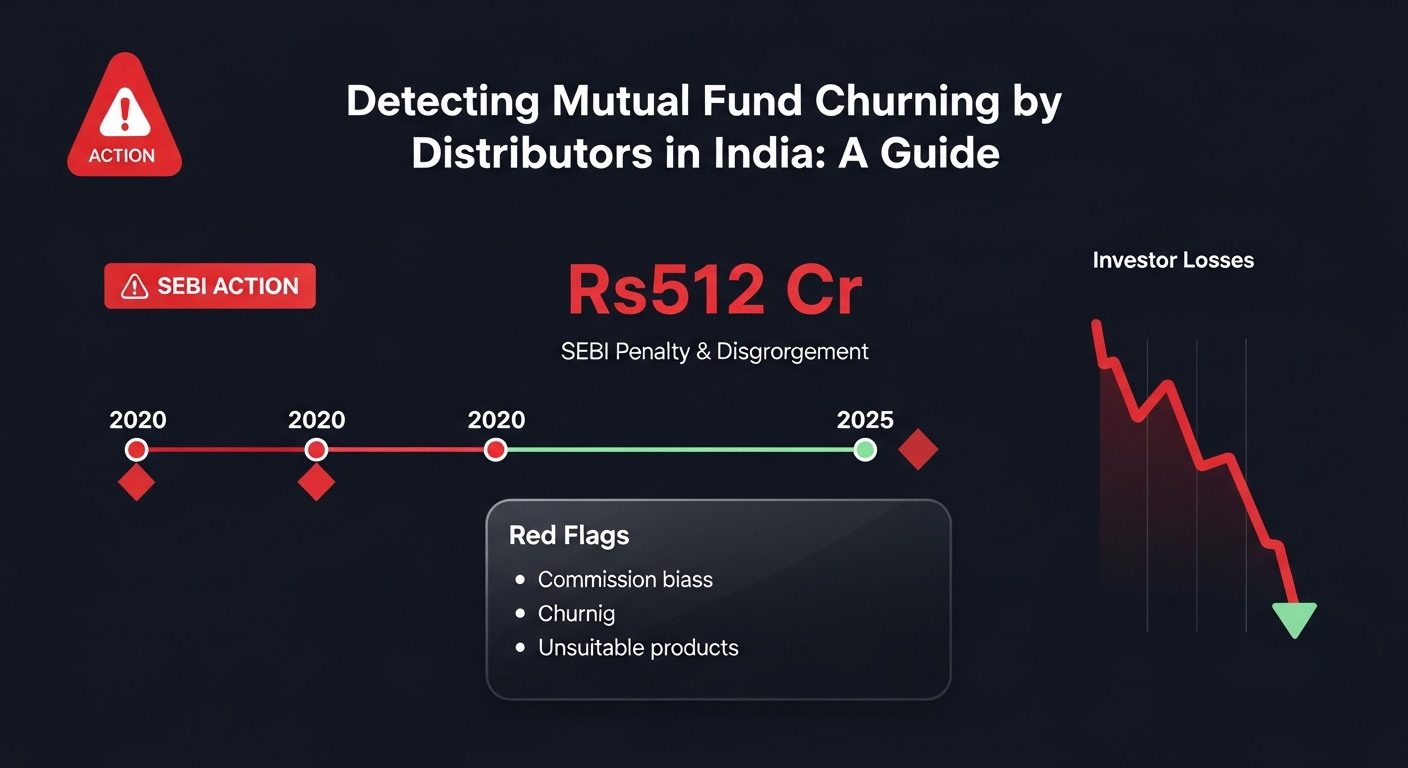
What Is Mutual Fund Churning by a Distributor?
Mutual fund churning by a distributor refers to the practice of initiating frequent and often unnecessary buying and selling of mutual fund units in an investor's portfolio. The primary motivation behind this unethical activity is for the distributor to earn higher upfront and trail commissions on each transaction, rather than serving the investor's best financial interests. This practice constitutes a form of mis-selling, which is strictly prohibited under SEBI regulations, as detailed in our guide on understanding mis-selling SEBI's regulatory framework.
Such activities typically involve switching between funds with similar investment mandates, redeeming units prematurely to avoid long-term capital gains, or investing in New Fund Offers (NFOs) without a clear strategic advantage for the investor. The cumulative effect is a significant drag on portfolio performance due to repeated exit loads, higher Total Expense Ratios (TERs) from regular plans, and avoidable short-term capital gains (STCG) taxes.
Why do distributors engage in mutual fund churning?
Distributors engage in mutual fund churning primarily to maximise their commission income. Mutual fund houses typically pay upfront commissions on new investments and trail commissions on the assets under management (AUM) they bring in. By constantly moving client funds, distributors can repeatedly earn upfront commissions, even if it's detrimental to the investor's long-term wealth creation. This is a conflict of interest that SEBI actively seeks to regulate.
What are the typical signs of portfolio churning?
Typical signs of portfolio churning include frequent switching between funds, particularly those with similar investment objectives or within the same SEBI categorisation (e.g., switching from one large-cap fund to another without a clear performance or strategy rationale). Other red flags are short holding periods for investments, recurrent incurrence of exit loads, and repeated short-term capital gains tax liabilities on your portfolio statements. Investors should also be wary if their distributor pushes for investments in multiple New Fund Offers (NFOs) in a short span.
How to Detect Mutual Fund Churning by Your Distributor
Detecting mutual fund churning requires a systematic review of your investment activity and a keen eye on the financial implications of your distributor's recommendations. By following these steps, you can identify patterns indicative of churning and protect your portfolio from unnecessary costs and eroded returns.
How can I review my transaction history for frequent switches?
Obtain your Consolidated Account Statement (CAS) from either CDSL or NSDL, or directly from AMFI, which compiles all your mutual fund transactions across fund houses. Scrutinise the dates of purchase and redemption for each fund. Look for instances where funds are redeemed within short periods, typically less than one year for equity funds, only to be reinvested in another fund soon after. This pattern identifies short holding periods that often incur exit loads and short-term capital gains tax.
How do I compare fund objectives and categories for redundancy?
Check the investment objectives and SEBI categorisation of the funds you've been switched into, as well as the funds you've exited. Use the official AMFI portal or fund factsheets to verify. Churning often involves moving money between funds that have largely similar mandates (e.g., two different flexi-cap funds or two different large-cap funds) without a discernible strategic advantage. SEBI's categorisation circular (SEBI/HO/IMD/DF3/CIR/P/2017/114 dated October 06, 2017) provides a clear framework for fund types, making it easier to spot redundant switches.
How can I analyse Total Expense Ratios (TERs) and exit loads incurred?
Access the Total Expense Ratio (TER) for both the regular and direct plans of your funds on the AMFI website. Compare the TER of the regular plans you were invested in against their direct plan counterparts. A significant difference (typically 0.50-1.10% lower for direct plans) combined with frequent switches, indicates a higher cost drag. Additionally, review your transaction statements for any \"exit load\" deductions, which are fees charged for redeeming units before a specified lock-in period, commonly 1% for equity funds redeemed within one year.
How do I identify unnecessary short-term capital gains tax implications?
Review your annual tax statements, specifically Form 26AS, and your mutual fund capital gains statements. Frequent redemptions within 12 months for equity funds typically trigger Short-Term Capital Gains (STCG) tax. As per the provided regulatory data, STCG on equity is taxed at 20.0%, which is significantly higher than the Long-Term Capital Gains (LTCG) tax of 10% on gains exceeding Rs 1,25,000 after one year. Repeated STCG liabilities are a strong indicator that your portfolio is being churned unnecessarily.
What are the steps to verify commission disclosures from my distributor?
Request a detailed commission disclosure statement from your distributor. Per SEBI circular SEBI/HO/IMD/DF2/CIR/P/2019/14 dated January 22, 2019, distributors are mandated to disclose all commissions received from mutual fund houses. Compare the commissions earned by your distributor against the volume and frequency of your transactions. Unusually high commission figures relative to your portfolio's size and activity, especially when coupled with poor net returns, warrant further investigation.
Quantifying the Cost of Churning: TER and Exit Load Impact
The financial impact of churning becomes evident when quantifying the additional costs borne by the investor. These costs primarily manifest as higher expense ratios and exit loads, directly eroding your net returns. Consider an investor who is frequently switched between regular plans by a distributor, instead of being advised to hold a direct plan of a suitable fund.
| Cost Component | Impact of Churning (Regular Plan) | Optimal Strategy (Direct Plan) |
|---|---|---|
| Total Expense Ratio (TER) | Higher by 0.50% to 1.10% (category-dependent) compared to Direct Plan. Deducted daily from NAV. | Lower, as no distributor commission is embedded. Example: Parag Parikh Flexi Cap Fund - Direct Plan TER ~0.70% vs. Regular Plan TER ~1.50%. |
| Exit Loads | Incurred frequently due to early redemptions. Typical 1% on equity redemptions within 1 year. | Generally avoided, as funds are held for the long term, past the exit load period. |
| Short-Term Capital Gains (STCG) Tax | Triggered by redemptions within 12 months (equity funds). Taxed at 20.0% (as per payload). | Avoided for long-term holdings (over 12 months for equity). LTCG is 10% on gains above Rs 1,25,000. |
| Opportunity Cost | Loss of compounding due to constant portfolio disruption and higher cost drag. | Maximized compounding potential due to lower costs and stable long-term investment. |
This table illustrates how the choice between a regular and direct plan, exacerbated by frequent switches, can significantly impact your portfolio's growth trajectory. The difference in TER alone, compounded over years, can lead to a substantial wealth gap.
A Worked Example: Unmasking Churning in a Rs 10 Lakh Portfolio
Let's illustrate the financial impact of churning with a hypothetical scenario involving an investor, Ms. Priya, who initially invests Rs 10,00,000. Her distributor makes frequent switches, always placing her in regular plans, leading to significant erosion of her potential wealth.
Scenario: Ms. Priya's Churned Portfolio
Ms. Priya invests Rs 10,00,000. We assume a gross pre-TER CAGR of 12% for all funds. The distributor's actions are as follows:
- Initial Investment: Rs 10,00,000 in HDFC Flexi Cap Fund - Regular Plan. Assumed TER: 1.60%.
- After 9 months: Distributor switches Ms. Priya to ICICI Prudential Bluechip Fund - Regular Plan. Assumed TER: 1.55%.
- After another 8 months: Distributor switches Ms. Priya to SBI Focused Equity Fund - Regular Plan. Assumed TER: 1.45%.
Calculations for Churned Portfolio:
- Phase 1 (HDFC Flexi Cap Fund - Regular Plan, 9 months):
- Initial Corpus: Rs 10,00,000
- Effective CAGR (12% - 1.60% TER): 10.40%
- Value after 9 months:
Rs 10,00,000 * (1 + 0.1040)^(9/12) = Rs 10,77,900 - Exit Load (1% on redemption within 1 year):
Rs 10,77,900 * 0.01 = Rs 10,779 - Gross Gain:
Rs 10,77,900 - Rs 10,00,000 = Rs 77,900 - STCG Tax (20.0% on Rs 77,900 gain, as per payload):
Rs 77,900 * 0.20 = Rs 15,580 - Net proceeds for next investment:
Rs 10,77,900 - Rs 10,779 - Rs 15,580 = Rs 10,51,541
- Phase 2 (ICICI Prudential Bluechip Fund - Regular Plan, 8 months):
- Corpus for this phase:
Rs 10,51,541 - Effective CAGR (12% - 1.55% TER): 10.45%
- Value after 8 months:
Rs 10,51,541 * (1 + 0.1045)^(8/12) = Rs 11,24,380 - Exit Load (1% on redemption within 1 year):
Rs 11,24,380 * 0.01 = Rs 11,244 - Gross Gain:
Rs 11,24,380 - Rs 10,51,541 = Rs 72,839 - STCG Tax (20.0% on Rs 72,839 gain, as per payload):
Rs 72,839 * 0.20 = Rs 14,568 - Final Corpus (Churned Portfolio):
Rs 11,24,380 - Rs 11,244 - Rs 14,568 = Rs 10,98,568
- Corpus for this phase:
Comparison: Optimal Strategy (Single Direct Plan)
Had Ms. Priya invested her initial Rs 10,00,000 in a single, well-chosen direct plan, such as HDFC Flexi Cap Fund - Direct Plan (Assumed TER: 0.80%), and held it for the entire 17-month period, her portfolio would have performed significantly better.
Free · No spam · Unsubscribe anytime
Learn investing without the jargon
Plain-English guides on MFs, SIPs, and taxes — one email a week, free forever.
- Initial Corpus:
Rs 10,00,000 - Effective CAGR (12% - 0.80% TER): 11.20%
- Value after 17 months:
Rs 10,00,000 * (1 + 0.1120)^(17/12) = Rs 11,61,000 - No Exit Load (held for >1 year).
- LTCG Tax: Gain
Rs 1,61,000. Taxable amount (above Rs 1,25,000 threshold):Rs 1,61,000 - Rs 1,25,000 = Rs 36,000. LTCG Tax (12.5% on Rs 36,000):Rs 36,000 * 0.125 = Rs 4,500. - Final Corpus (Optimal Portfolio):
Rs 11,61,000 - Rs 4,500 = Rs 11,56,500
The Cost of Churning
By comparing the two scenarios, the financial impact of churning becomes stark:
- Final Corpus (Optimal Direct Plan): Rs 11,56,500
- Final Corpus (Churned Regular Plans): Rs 10,98,568
- Wealth Erosion Due to Churning: Rs 11,56,500 - Rs 10,98,568 = Rs 57,932
In just 17 months, Ms. Priya lost nearly Rs 58,000 due to unnecessary switches, higher expense ratios, and avoidable taxes, demonstrating the critical need to detect and prevent mutual fund churning.
Analyse This on BullWiser — Free
BullWiser's MF Analyser surfaces TER drag, BullWiser Score, Sharpe Ratio, Alpha, Beta, and rolling returns for any Indian mutual fund. Compare funds side by side or upload your CAS statement to diagnose your full portfolio's weighted expense load and overlap.
Open BullWiser MF Analyser →Common Misconceptions About Mutual Fund Churning
Understanding what churning is not, is as crucial as knowing what it is. Several misconceptions can lead investors to either overlook genuine churning or mistakenly accuse distributors of ethical practices.
Is frequent rebalancing always a sign of churning?
No, frequent rebalancing is not always a sign of churning. Legitimate portfolio rebalancing is a strategic exercise performed periodically (e.g., annually or semi-annually) to realign a portfolio's asset allocation with an investor's target risk profile and financial goals. It is driven by market movements and the investor's evolving needs, not by the distributor's commission incentives. Churning, conversely, involves excessive, unwarranted transactions that primarily benefit the distributor.
Do direct plans eliminate the risk of churning?
Direct plans significantly reduce the risk of distributor-driven churning because they do not involve commission payments to intermediaries. However, they do not eliminate the risk of an investor 'self-churning' their portfolio due to impulsive decisions or influence from unregulated advisors. While direct plans remove the intermediary's financial incentive for churning, investors must still exercise diligence and invest based on sound financial planning.
Is churning only about high-commission funds?
Churning is not exclusively about high-commission funds. While distributors might prefer funds with higher upfront commissions, churning can occur with any fund if the distributor sees an opportunity to generate repeated transaction-based income. The focus of churning is on the *frequency* and *necessity* of transactions, rather than the intrinsic quality or commission structure of a specific fund. Even a good fund can be part of a churned portfolio if it's repeatedly bought and sold prematurely.
Frequently Asked Questions About Mutual Fund Churning
What is the difference between rebalancing and churning?
Rebalancing is a strategic, investor-initiated adjustment of portfolio asset allocation to maintain a desired risk profile. Churning is frequent, unnecessary trading by a distributor, primarily for earning commissions, not for the investor's benefit. Rebalancing aims for portfolio health, while churning aims for distributor income. This is a key distinction.
Can I recover losses from mutual fund churning?
Yes, you may be able to recover losses through formal complaints to SEBI SCORES or by pursuing legal action. Document all communications and transactions meticulously. It's crucial to act promptly once you detect suspicious activity. Seeking legal counsel is often advisable.
How do SEBI regulations address mutual fund churning?
SEBI prohibits mis-selling practices like churning and mandates transparency through circulars like SEBI/HO/IMD/DF2/CIR/P/2019/14, requiring distributors to disclose commissions. Investors can file complaints via the SEBI SCORES platform. This helps protect investors from unethical practices.
Does switching from a regular to a direct plan count as churning?
No, switching from a regular to a direct plan for the same fund is generally beneficial for the investor due to lower TER, saving 0.50-1.10% annually. This is a prudent financial decision, not churning, as it reduces costs and improves net returns. It's a smart move for many investors.
What should I do if I suspect my distributor is churning my portfolio?
If you suspect churning, immediately gather your Consolidated Account Statement (CAS), transaction details, and all communication records. Then, formally complain to the fund house and file a grievance on the SEBI SCORES platform. This is a critical first step to initiate an investigation. You should also consider consulting a SEBI-registered investment adviser.
Are there specific periods when churning is more likely?
Churning can occur at any time but might be more prevalent during market volatility or when distributors are incentivized by new fund offers (NFOs) or higher upfront commissions. Always stay vigilant and review your portfolio regularly, regardless of market conditions. Proactive monitoring helps mitigate risks.
Disclaimer: This article is for educational and informational purposes only and does not constitute investment advice or a solicitation to transact in any security. Mutual fund investments are subject to market risks. Past performance is not indicative of future returns. All regulatory data referenced is subject to change — verify current SEBI and AMFI guidelines on official sources. Consult a SEBI-registered investment adviser before making any financial decision.
For a complete list of SEBI-registered investment advisers, visit the official SEBI portal: SEBI Registered Investment Advisers.