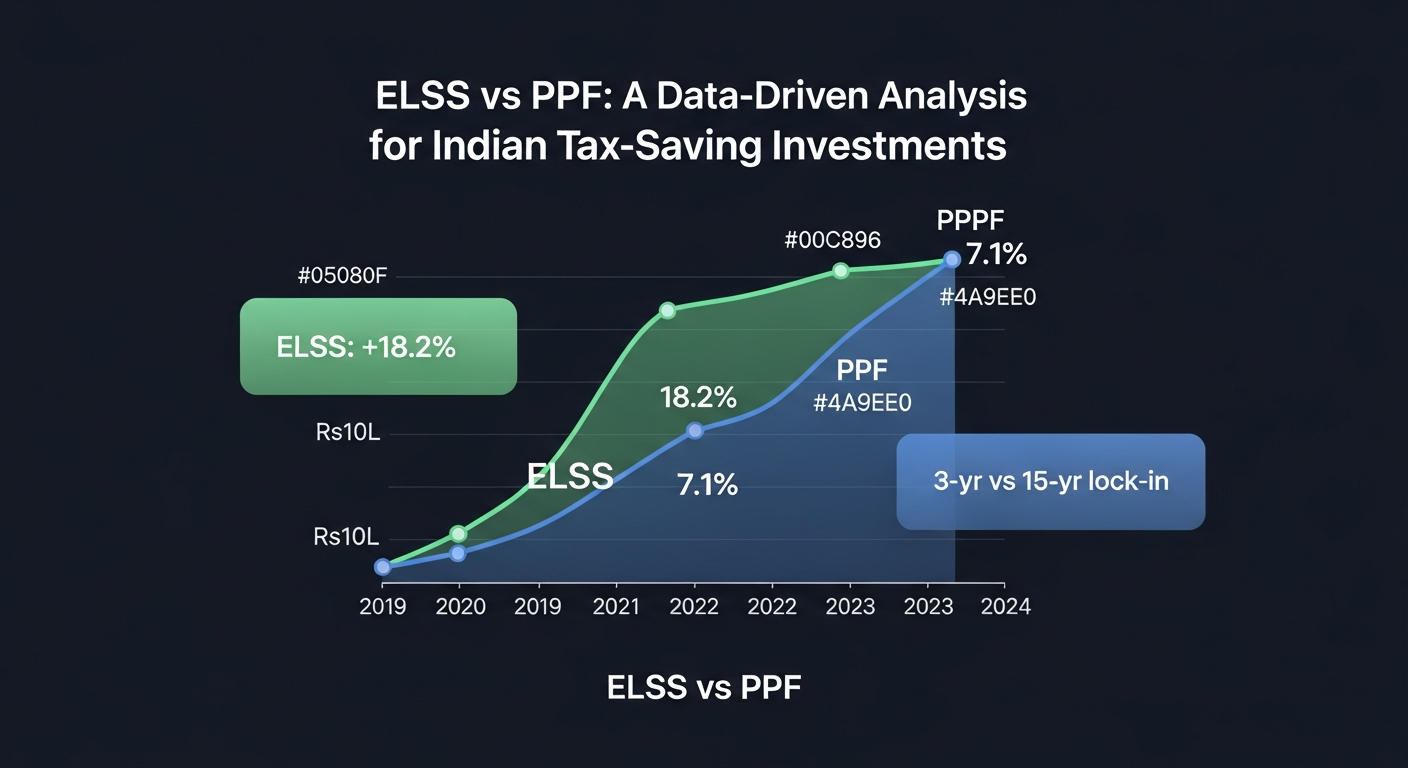
What is the Fundamental Difference Between ELSS and PPF in India?
The fundamental difference between ELSS (Equity Linked Savings Scheme) and PPF (Public Provident Fund) in India lies primarily in their underlying asset classes, risk profiles, and liquidity structures. While both qualify for tax deductions under Section 80C of the Income Tax Act, 1961, up to Rs 1.5 lakh annually, ELSS invests in equities, exposing investors to market volatility for potentially higher returns, whereas PPF is a fixed-income instrument offering sovereign-backed safety and guaranteed interest.
Why is ELSS considered riskier than PPF?
ELSS funds are equity mutual funds, meaning a significant portion of their portfolio is invested in stocks across various market capitalisations, as per SEBI circular SEBI/HO/IMD/DF3/CIR/P/2017/114 dated October 6, 2017, on scheme categorisation. This direct exposure to equity markets makes ELSS returns susceptible to market fluctuations, economic cycles, and company-specific performance, thereby carrying a higher risk profile. Conversely, PPF is a fixed-income scheme administered by the Government of India, offering a guaranteed interest rate (e.g., 7.1% per annum for Q1 FY 2024-25), with capital and interest entirely backed by the sovereign, making it a virtually risk-free investment.
How do their lock-in periods affect liquidity?
The lock-in periods of ELSS and PPF significantly impact investor liquidity. ELSS has the shortest lock-in period among all Section 80C instruments, at 3 years from the date of investment for each unit. After this period, units can be redeemed, offering relatively quicker access to funds. PPF, however, mandates a 15-year lock-in period, which can be extended in blocks of 5 years. While partial withdrawals are permitted after 6 years under specific conditions, and a loan facility is available from the 3rd to 6th year, the capital remains largely illiquid for a substantial duration. This extended lock-in ensures long-term capital accumulation but restricts immediate access.
How Do ELSS and PPF Mechanically Generate Returns and Offer Tax Benefits?
ELSS funds generate returns through capital appreciation of their underlying equity holdings and dividend income, with their value reflecting in the daily Net Asset Value (NAV). PPF, on the other hand, generates returns through a fixed interest rate, declared quarterly by the government, which compounds annually. Both instruments provide tax benefits by allowing deductions up to Rs 1.5 lakh from taxable income under Section 80C of the Income Tax Act, 1961.
What investment mechanisms drive ELSS growth?
ELSS funds operate like other diversified equity mutual funds, pooling money from multiple investors to invest in a basket of stocks. Fund managers actively manage this portfolio, aiming to outperform their benchmark by selecting promising companies across market capitalisations (large, mid, and small-cap segments as defined by SEBI/AMFI). Returns are generated from the appreciation in the value of these stocks and any dividends received. The daily NAV reflects the market value of the fund's assets less its Total Expense Ratio (TER). For instance, an investment in Taurus ELSS Tax Saver Fund - Direct Plan - Growth, with a NAV of Rs 197.58000 as of July 28, 2026, grows as the underlying stock portfolio performs.
How is PPF interest calculated and compounded?
PPF interest is calculated on the lowest balance between the 5th and the last day of each month and credited to the account annually, typically on March 31st. The interest rate is declared quarterly by the Ministry of Finance and remains fixed for that quarter. For example, if the rate is 7.1% per annum, this interest is compounded annually, meaning the interest earned in one year is added to the principal for the next year's interest calculation. This compounding effect, combined with the long 15-year tenure, allows for significant wealth accumulation, entirely tax-free under the EEE (Exempt-Exempt-Exempt) regime.
A Structural Comparison: ELSS vs PPF Key Metrics
Understanding the core structural differences between ELSS and PPF is crucial for informed tax planning. The table below details key metrics across investment type, risk, lock-in, tax benefits, and liquidity, highlighting their distinct characteristics as of FY 2024-25.
| Feature | ELSS (Equity Linked Savings Scheme) | PPF (Public Provident Fund) |
|---|---|---|
| Investment Type | Equity Mutual Fund | Government-backed Fixed Income |
| Risk Profile | High (Market-linked) | Low (Sovereign-backed) |
| Lock-in Period | 3 years (per unit) | 15 years (extendable in 5-year blocks) |
| Tax Benefit (Section 80C) | Up to Rs 1.5 Lakh deduction | Up to Rs 1.5 Lakh deduction |
| Taxation of Returns | LTCG 10% on gains > Rs 1 Lakh (Section 112A) | Exempt-Exempt-Exempt (EEE) |
| Liquidity | Redeemable after 3 years | Partial withdrawals after 6 years, full at maturity (15 years) |
| Potential Returns | High (Market-dependent) | Moderate (Fixed interest rate, e.g., 7.1% p.a. for Q1 FY2024-25) |
| Expense Ratio (TER) | Applicable (e.g., 0.80% for Direct Plans) | Not Applicable |
Quantifying the Long-Term Impact: ELSS vs PPF with Worked Examples
To illustrate the compounded difference between ELSS and PPF, let's consider a disciplined Systematic Investment Plan (SIP) of Rs 10,000 per month (Rs 1.2 lakh per annum) in each instrument over a 15-year period. This helps quantify the potential corpus difference and the impact of taxation and expense ratios.
Example 1: Rs 10,000 Monthly SIP Over 15 Years
Consider an investor contributing Rs 10,000 per month for 15 years, totaling an investment of Rs 18,00,000. We will project the final corpus for both ELSS and PPF using illustrative CAGR assumptions and applying relevant costs and taxes.
Scenario A: ELSS Investment (Taurus ELSS Tax Saver Fund - Direct Plan - Growth)
- Monthly SIP: Rs 10,000
- Annual Investment: Rs 1,20,000
- Total Investment Period: 15 years
- Total Invested Corpus: Rs 18,00,000
- Assumed Gross CAGR (Pre-TER): 12% p.a. (illustrative for equity over 15 years)
- Assumed Direct Plan TER: 0.80% p.a. (as per typical Direct Plan ELSS funds, as of FY2024-25)
Calculation:
Effective CAGR after TER = 12% - 0.80% = 11.20%
Future Value of SIP (FV) = P * [((1 + r)^n - 1) / r] * (1 + r)
- P = Rs 10,000
- r = 11.20% / 12 = 0.009333 (monthly rate)
- n = 15 years * 12 months = 180
Projected Corpus (Pre-Tax): Rs 40,84,650 (approx.)
Total Capital Gains: Rs 40,84,650 - Rs 18,00,000 = Rs 22,84,650
Taxation Impact (as of FY2024-25):
LTCG exemption per financial year: Rs 1,00,000. For simplicity, assuming redemption in one go, the entire gain is subject to LTCG. In reality, phased withdrawal over multiple financial years can optimise tax. For this example, let's assume a single redemption.
Taxable Gains: Rs 22,84,650 - Rs 1,00,000 (annual exemption) = Rs 21,84,650
LTCG Tax @ 10%: 10% of Rs 21,84,650 = Rs 2,18,465
Free · No spam · Unsubscribe anytime
Never miss an LTCG harvesting window
Tax-saving alerts before March 31, indexation tips, and LTCG impact breakdowns — free.
Net Corpus after LTCG Tax: Rs 40,84,650 - Rs 2,18,465 = Rs 38,66,185
Scenario B: PPF Investment
- Monthly Investment: Rs 10,000
- Annual Investment: Rs 1,20,000
- Total Investment Period: 15 years
- Total Invested Corpus: Rs 18,00,000
- Assumed Interest Rate: 7.1% p.a. (illustrative, based on Q1 FY2024-25 rate, compounded annually)
Calculation:
Projected Corpus (after 15 years, using PPF calculator for Rs 1.2 lakh annual contribution at 7.1%): Rs 38,27,000 (approx.)
Total Capital Gains/Interest: Rs 38,27,000 - Rs 18,00,000 = Rs 20,27,000
Taxation Impact (as of FY2024-25):
PPF returns are EEE (Exempt-Exempt-Exempt), meaning the entire corpus and interest are tax-free upon maturity.
Net Corpus after Tax: Rs 38,27,000
Summary Comparison (Illustrative):
| Metric | ELSS (Direct Plan) | PPF |
|---|---|---|
| Total Invested (15 years) | Rs 18,00,000 | Rs 18,00,000 |
| Illustrative Gross CAGR/Interest | 12.00% | 7.10% |
| Effective Return (after TER/before LTCG) | 11.20% | 7.10% |
| Projected Corpus (Pre-Tax) | Rs 40,84,650 | Rs 38,27,000 |
| Net Corpus (After Tax) | Rs 38,66,185 | Rs 38,27,000 |
| Net Gain Over Invested Amount | Rs 20,66,185 | Rs 20,27,000 |
This example highlights that while ELSS has the potential for higher gross returns, the LTCG tax can narrow the gap with the entirely tax-free PPF, especially when considering the sovereign safety and fixed returns of PPF. The actual ELSS returns can vary significantly based on market performance.
Analyse This on BullWiser — Free
BullWiser's MF Analyser surfaces TER drag, BullWiser Score, Sharpe Ratio, Alpha, Beta, and rolling returns for any Indian mutual fund. Compare funds side by side or upload your CAS statement to diagnose your full portfolio's weighted expense load and overlap.
Open BullWiser MF Analyser →Common Misconceptions About ELSS and PPF
Investors often carry preconceived notions about ELSS and PPF that can lead to suboptimal financial decisions. It's crucial to address these misconceptions with data-backed insights to ensure a clear understanding of each instrument's role.
Is it true that ELSS is only for aggressive investors?
While ELSS funds are equity-oriented and thus carry market risk, classifying them as solely for 'aggressive' investors is a misconception. Their 3-year lock-in period, the shortest among 80C instruments, inherently encourages a medium-term investment horizon, which can help mitigate short-term market volatility. For investors with a moderate risk appetite and a time horizon of 5-7 years or more, ELSS can be a suitable component of a diversified portfolio, especially when investing through SIP to average out costs. The key is understanding risk metrics like standard deviation and Beta for specific ELSS funds.
Does PPF always offer better tax-free returns than ELSS?
It's a common belief that PPF's EEE (Exempt-Exempt-Exempt) status automatically makes its post-tax returns superior to ELSS, which is subject to LTCG tax. However, this is not always true. While PPF's interest is entirely tax-free, its return rate is fixed and generally lower than the potential long-term returns from equity markets. ELSS, despite LTCG tax (10% on gains over Rs 1 lakh), can generate significantly higher gross returns over the long term (e.g., 12-15% CAGR for equity vs. 7-8% for PPF). If an ELSS fund delivers a substantially higher pre-tax return, its net post-tax return can still surpass PPF, even after accounting for LTCG. The outperformance depends entirely on market conditions and fund manager skill, quantified by metrics like Sharpe Ratio and Alpha.
Can I redeem my ELSS investment anytime after 3 years without charges?
While the mandatory 3-year lock-in period for ELSS is fixed, investors should be aware of potential exit loads. Some ELSS funds may impose an exit load if units are redeemed within a specific short window after the 3-year lock-in, typically 1% if redeemed within 1 year of the lock-in expiry. This is fund-specific and should be checked in the Scheme Information Document (SID). While not as common as in other equity funds, it's not universally true that ELSS redemptions are always free of charges immediately after the 3-year lock-in. Always verify the specific fund's exit load policy at the time of investment.
Frequently Asked Questions About ELSS and PPF
Is ELSS better than PPF for tax saving?
Neither ELSS nor PPF is inherently 'better'; their suitability depends on an investor's risk appetite and investment horizon. ELSS offers equity exposure for potentially higher returns over its 3-year lock-in, whereas PPF provides guaranteed, tax-free returns with a 15-year lock-in period. Choose based on your comfort with market volatility and liquidity needs.
What is the lock-in period for ELSS and PPF?
ELSS funds have a mandatory lock-in period of 3 years from the date of investment for each unit. In contrast, PPF has a much longer lock-in period of 15 years. Both instruments serve distinct liquidity profiles for tax-saving goals.
How are returns from ELSS and PPF taxed?
Returns from ELSS are subject to Long Term Capital Gains (LTCG) tax at 10% on gains exceeding Rs 1 lakh in a financial year, as per Section 112A of the Income Tax Act, 1961. PPF returns, including interest and maturity proceeds, are entirely tax-exempt under the EEE (Exempt-Exempt-Exempt) regime. This makes PPF a completely tax-free investment.
Can I invest more than Rs 1.5 lakh in ELSS or PPF?
Yes, you can invest more than Rs 1.5 lakh in both ELSS and PPF, but the tax deduction under Section 80C of the Income Tax Act, 1961, is capped at Rs 1.5 lakh annually across all eligible instruments. Any investment beyond this limit in either instrument will not provide additional tax benefits. It’s important to understand the maximum tax benefit.
What is the risk profile of ELSS versus PPF?
ELSS carries a higher risk profile as it invests predominantly in equity markets, making its returns subject to market volatility. PPF, being a government-backed scheme, offers a very low-risk profile with guaranteed returns and capital protection. Your risk tolerance should guide your choice between them.
Does ELSS have an expense ratio like other mutual funds?
Yes, ELSS funds have a Total Expense Ratio (TER) just like other mutual funds, which is deducted from the fund's assets daily. This TER covers management fees and operational costs. PPF, on the other hand, does not have an expense ratio as it is a government-administered scheme. Check the TER for Direct Plans for efficiency.
Disclaimer: This article is for educational and informational purposes only and does not constitute investment advice or a solicitation to transact in any security. Mutual fund investments are subject to market risks. Past performance is not indicative of future returns. All regulatory data referenced is subject to change — verify current SEBI and AMFI guidelines on official sources. Consult a SEBI-registered investment adviser before making any financial decision.
For a complete list of SEBI-registered investment advisers, visit the official SEBI portal: SEBI Registered Investment Advisers.