What Are Long-Term and Short-Term Capital Gains in Mutual Funds?
Long-Term Capital Gains (LTCG) and Short-Term Capital Gains (STCG) in mutual funds refer to the profit realised from selling fund units, with the classification depending on the holding period. For equity-oriented mutual funds, a holding period of more than 12 months qualifies for LTCG, while 12 months or less is considered STCG. For non-equity oriented funds (debt, gold, international funds), the threshold for LTCG is typically more than 36 months, with 36 months or less classifying as STCG. Understanding these distinctions is crucial for effective tax planning, especially when comparing investment avenues like ELSS vs PPF vs NPS.
What defines an equity-oriented mutual fund for tax purposes?
An equity-oriented mutual fund is defined by the Income Tax Act as a fund that invests at least 65% of its corpus in Indian equities. This classification, aligned with SEBI's categorisation framework (e.g., SEBI/HO/IMD/DF3/CIR/P/2017/114 dated October 6, 2017), determines whether capital gains are taxed under the more favourable equity-specific rules. Funds falling below this 65% equity allocation threshold are generally considered non-equity oriented for tax purposes, even if they hold some equities.
How does the holding period impact capital gains classification?
The holding period directly dictates whether a profit from mutual fund redemption is treated as a short-term or long-term capital gain. For equity funds, if you hold units for more than 12 months, any profit is LTCG; otherwise, it's STCG. For debt and other non-equity funds, the LTCG threshold is a holding period exceeding 36 months, with profits from units held for 36 months or less classified as STCG.
How Are Mutual Fund Capital Gains Calculated and Taxed?
Mutual fund capital gains are calculated as the difference between the Net Asset Value (NAV) at the time of redemption and the NAV at the time of purchase, multiplied by the number of units. The calculation of NAV, which forms the basis of capital gains, is strictly governed by SEBI regulations, such as SEBI/HO/IMD/DF2/CIR/P/2018/137 dated October 22, 2018, concerning the valuation of money market and debt securities. The taxation rate then depends on whether these gains are long-term or short-term, and whether the fund is equity-oriented or non-equity oriented, as per the Income Tax Act.
The formula for calculating Capital Gain (CG) is:
$$ \text{Capital Gain (CG)} = (\text{Redemption NAV} - \text{Purchase NAV}) \times \text{Number of Units} $$
This calculated gain is then subjected to specific tax rates, applicable as of FY 2024-25:
- Equity-Oriented Funds (>= 65% equity exposure):
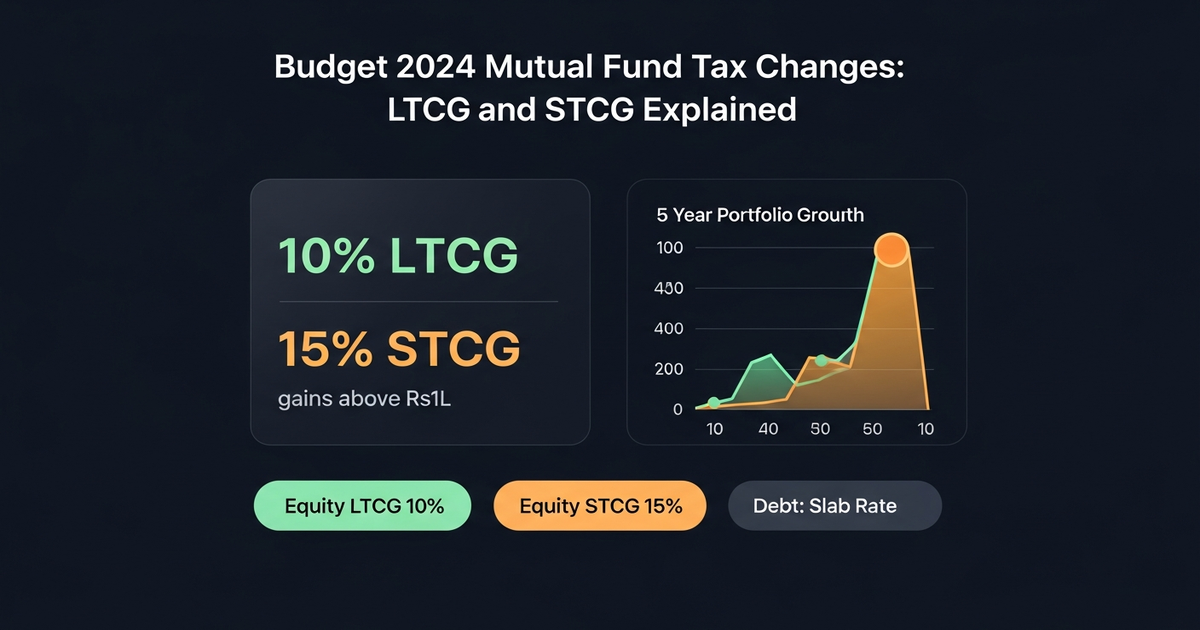
- STCG (holding <= 12 months): Taxed at a flat 15% rate, irrespective of your income tax slab.
- LTCG (holding > 12 months): Taxed at 10% on gains exceeding ₹1,00,000 in a financial year, without the benefit of indexation. This rule was introduced by the Finance Act, 2018.
- Non-Equity Oriented Funds (< 65% equity exposure), including Debt Funds:
- STCG (holding <= 36 months): Taxed at your individual income tax slab rate.
- LTCG (holding > 36 months): For units purchased on or after April 1, 2023, these gains are also taxed at your individual income tax slab rate, effectively removing the indexation benefit previously available. For units purchased before April 1, 2023, LTCG is taxed at 20% with the benefit of indexation.
What are the specific tax rates for equity mutual fund gains?
Equity mutual fund gains are subject to two primary tax rates depending on the holding period. Short-term capital gains (STCG) from units held for 12 months or less are taxed at a flat 15%, while long-term capital gains (LTCG) from units held for more than 12 months are taxed at 10% on gains exceeding ₹1,00,000 in a financial year. This ₹1,00,000 exemption limit applies cumulatively across all equity-oriented funds in a single financial year.
How has debt mutual fund taxation changed after April 2023?
The taxation for debt mutual funds underwent a significant change with the Finance Act, 2023, effective April 1, 2023. For all debt fund units purchased on or after this date, both short-term and long-term capital gains are now taxed at the investor's applicable individual income tax slab rate. This means the benefit of indexation for LTCG, which previously reduced the taxable gain, has been removed for new purchases.
Comparative Overview of Mutual Fund Capital Gains Taxation (FY 2024-25)
The table below provides a clear comparison of how capital gains from different types of mutual funds are taxed, highlighting the distinctions between equity and non-equity oriented schemes, and the impact of the April 2023 changes for debt funds. This framework is essential for investors navigating the Indian tax landscape.
| Fund Type & Holding Period | Tax Rate (FY 2024-25) | Indexation Benefit | Key Provisions/Thresholds |
|---|---|---|---|
| Equity-Oriented Funds: | (Min. 65% equity exposure) | ||
| STCG (<= 12 months) | 15% | No | Flat rate, regardless of slab |
| LTCG (> 12 months) | 10% | No | On gains exceeding ₹1,00,000 per FY (Finance Act, 2018) |
| Non-Equity Oriented Funds (Debt, Gold, FoF): | (Purchased on/after April 1, 2023) | ||
| STCG (<= 36 months) | As per income tax slab | No | No specific threshold |
| LTCG (> 36 months) | As per income tax slab | No | No specific threshold; indexation removed |
| Non-Equity Oriented Funds (Debt, Gold, FoF): | (Purchased before April 1, 2023) | ||
| STCG (<= 36 months) | As per income tax slab | No | No specific threshold |
| LTCG (> 36 months) | 20% | Yes | With indexation benefit |
Worked Examples: Calculating Mutual Fund Tax Liability
To illustrate the practical impact of these tax rules, let's examine two scenarios involving an equity fund and a debt fund. These examples will demonstrate how capital gains are calculated and the resulting tax liability for an investor in the highest tax bracket (30%).
Example 1: Equity Fund Long-Term Capital Gains (LTCG)
Consider an investor who invested in Parag Parikh Flexi Cap Fund - Direct Plan and redeems after a long holding period.
Scenario Details:
- Fund: Parag Parikh Flexi Cap Fund - Direct Plan (Illustrative)
- Investment Date: April 1, 2020
- Redemption Date: May 1, 2025 (Holding Period: > 12 months, hence LTCG)
- Units Purchased: 1,000 units
- Purchase NAV: ₹35.00 (Illustrative)
- Redemption NAV: ₹90.00 (Illustrative)
- Investor's Tax Slab: 30%
Calculation:
- Total Investment Value: 1,000 units * ₹35.00/unit = ₹35,000
- Total Redemption Value: 1,000 units * ₹90.00/unit = ₹90,000
- Gross Capital Gain: ₹90,000 - ₹35,000 = ₹55,000
- Taxable LTCG: Since the gain of ₹55,000 is less than the ₹1,00,000 exemption limit for equity LTCG, the Taxable LTCG is ₹0.
- Tax Liability: ₹0
Scenario 2: Equity Fund Long-Term Capital Gains (LTCG) - Exceeding Threshold
Free · No spam · Unsubscribe anytime
Never miss an LTCG harvesting window
Tax-saving alerts before March 31, indexation tips, and LTCG impact breakdowns — free.
Let's modify the above example to show a gain exceeding the threshold.
Scenario Details:
- Fund: Parag Parikh Flexi Cap Fund - Direct Plan (Illustrative)
- Investment Date: April 1, 2020
- Redemption Date: May 1, 2025 (Holding Period: > 12 months, hence LTCG)
- Units Purchased: 5,000 units
- Purchase NAV: ₹35.00 (Illustrative)
- Redemption NAV: ₹90.00 (Illustrative)
- Investor's Tax Slab: 30%
Calculation:
- Total Investment Value: 5,000 units * ₹35.00/unit = ₹1,75,000
- Total Redemption Value: 5,000 units * ₹90.00/unit = ₹4,50,000
- Gross Capital Gain: ₹4,50,000 - ₹1,75,000 = ₹2,75,000
- Taxable LTCG: ₹2,75,000 - ₹1,00,000 (exemption limit) = ₹1,75,000
- Tax Liability: ₹1,75,000 * 10% = ₹17,500 (plus applicable cess and surcharge, as of FY 2024-25)
Example 2: Debt Fund Capital Gains (Post-April 2023 Purchase)
Consider an investor in HDFC Liquid Fund - Direct Plan.
Scenario Details:
- Fund: HDFC Liquid Fund - Direct Plan (Illustrative)
- Investment Date: June 1, 2023 (Post-April 1, 2023, hence slab rate applies)
- Redemption Date: December 1, 2024 (Holding Period: > 12 months, but < 36 months. Still taxed at slab rate post Apr 2023)
- Units Purchased: 10,000 units
- Purchase NAV: ₹1,000.00 (Illustrative)
- Redemption NAV: ₹1,080.00 (Illustrative)
- Investor's Tax Slab: 30%
Calculation:
- Total Investment Value: 10,000 units * ₹1,000.00/unit = ₹10,00,000
- Total Redemption Value: 10,000 units * ₹1,080.00/unit = ₹10,80,000
- Gross Capital Gain: ₹10,80,000 - ₹10,00,000 = ₹80,000
- Taxable Gain: ₹80,000 (no indexation benefit, taxed entirely at slab rate)
- Tax Liability: ₹80,000 * 30% = ₹24,000 (plus applicable cess and surcharge, as of FY 2024-25). This gain is added to the investor's gross total income.
Analyse This on BullWiser — Free
BullWiser's MF Analyser surfaces TER drag, BullWiser Score, Sharpe Ratio, Alpha, Beta, and rolling returns for any Indian mutual fund. Compare funds side by side or upload your CAS statement to diagnose your full portfolio's weighted expense load and overlap.
Open BullWiser MF Analyser →Common Misconceptions About Mutual Fund Tax Changes
Several misunderstandings persist regarding mutual fund taxation, especially with recent budget updates. Clarifying these can help investors make more informed decisions and avoid unexpected tax liabilities.
Is it true that all mutual fund gains are now taxed at my slab rate?
No, it is not true that all mutual fund gains are taxed at your slab rate. This change primarily applies to debt mutual funds and other non-equity oriented funds purchased on or after April 1, 2023, where both STCG and LTCG are now taxed at your individual income tax slab rate. Equity-oriented funds still follow the 15% STCG and 10% LTCG (above ₹1 lakh) regime.
Do Budget 2024 tax changes apply retroactively to all my existing investments?
No, Budget 2024 tax changes, or any prior budget changes, typically do not apply retroactively to all existing investments. The significant change for debt funds, for instance, explicitly applies only to units purchased on or after April 1, 2023. Investments made before this date continue to be governed by the older tax rules, including the indexation benefit for long-term gains.
Can I claim tax benefits for all types of mutual funds?
No, you cannot claim direct tax benefits for all types of mutual funds under Section 80C. Only Equity-Linked Savings Schemes (ELSS) qualify for deductions under Section 80C of the Income Tax Act, up to a limit of ₹1,50,000 per financial year, subject to a 3-year lock-in period. Other mutual fund categories like large cap, mid cap, or small cap funds do not offer direct tax deductions on investment, though their capital gains are taxed differently.
Frequently Asked Questions About Mutual Fund Tax Changes
How does the ₹1 lakh LTCG exemption work for equity funds?
The ₹1 lakh LTCG exemption for equity funds means that long-term capital gains up to ₹1,00,000 in a financial year are entirely tax-free. Only gains exceeding this threshold are taxed at 10%. This is a per-financial-year cumulative limit across all equity funds, making it an important consideration for investors.
What is the indexation benefit and why was it removed for debt funds?
Indexation benefit adjusts the purchase cost of an asset for inflation, reducing the taxable capital gain. It was removed for debt funds purchased after April 1, 2023, by the Finance Act 2023, to rationalise taxation and bring debt mutual funds in line with fixed deposit taxation. The government aimed to level the playing field for various investment instruments.
Are dividends from mutual funds taxable in India?
Yes, dividends from mutual funds are taxable in India as per the investor's income tax slab rate. Since April 1, 2020, the Dividend Distribution Tax (DDT) was abolished, and dividends are now fully taxable in the hands of the recipient. This change simplified the dividend taxation regime.
Do I pay tax if I switch between mutual fund schemes?
Yes, switching between mutual fund schemes is considered a redemption from one fund and a fresh purchase in another, and it triggers a capital gains event. Any gains realised from the fund you are exiting will be subject to applicable STCG or LTCG tax, even if the money is immediately reinvested. Be mindful of this tax implication when rebalancing your portfolio.
Is there a separate tax for international mutual funds?
International mutual funds are generally treated as non-equity oriented funds for tax purposes. This means their capital gains are taxed at your individual income tax slab rate, without indexation benefits for units purchased after April 1, 2023. It's crucial to understand this distinction for global investments.
How often are mutual fund tax rules updated?
Mutual fund tax rules are typically updated annually during the Union Budget presentation, usually in February, with changes often becoming effective from April 1. Significant changes can also be introduced through Finance Acts during the year. Staying informed about these updates is crucial for investors.
Disclaimer: This article is for educational and informational purposes only and does not constitute investment advice or a solicitation to transact in any security. Mutual fund investments are subject to market risks. Past performance is not indicative of future returns. All regulatory data referenced is subject to change — verify current SEBI and AMFI guidelines on official sources. Consult a SEBI-registered investment adviser before making any financial decision.
For a complete list of SEBI-registered investment advisers, visit the official SEBI portal: SEBI Registered Investment Advisers.