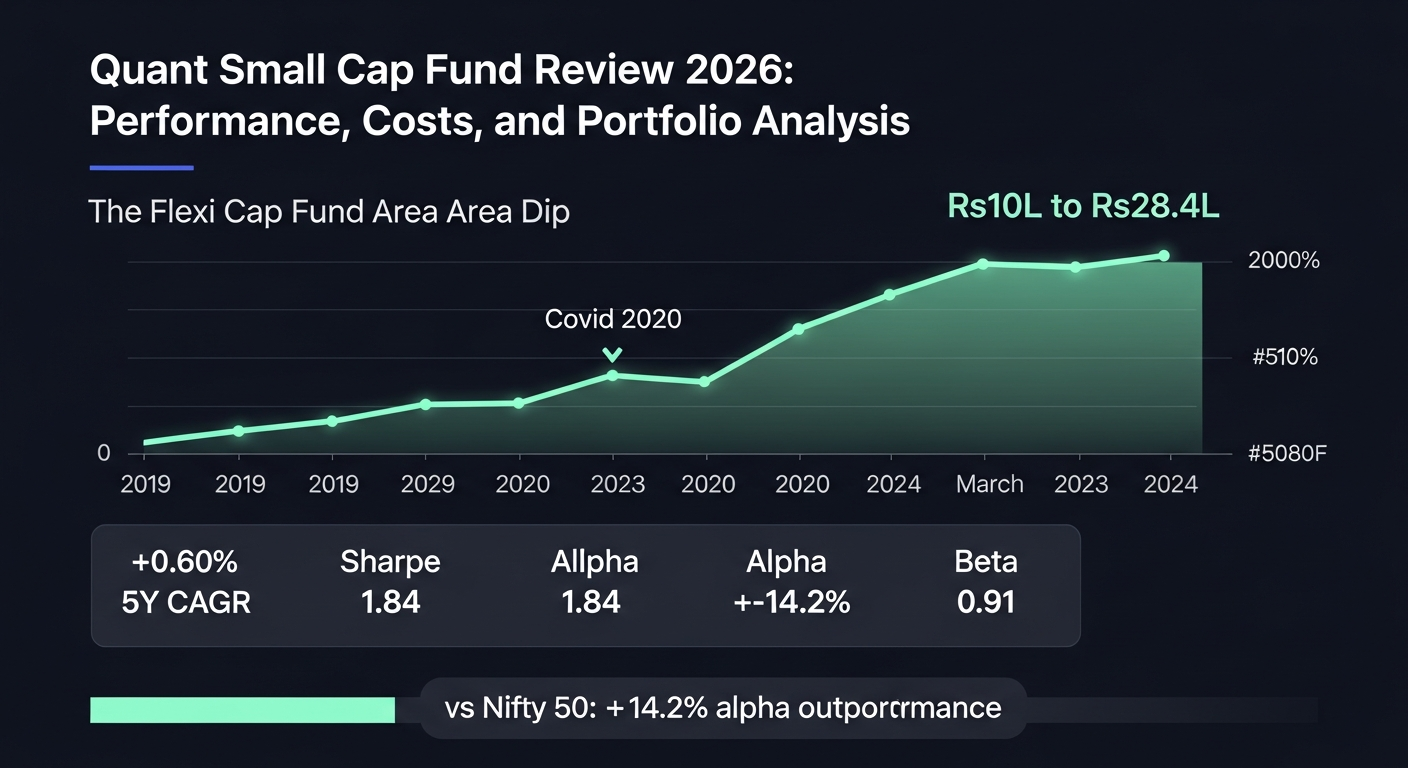
Quant Small Cap Fund — Key Facts at a Glance
The Quant Small Cap Fund is an open-ended equity scheme investing predominantly in small-cap stocks, defined by SEBI circular SEBI/HO/IMD/DF3/CIR/P/2017/114 dated October 6, 2017, as companies ranking 251st onwards in terms of full market capitalization. This positioning allows the fund to tap into high-growth potential businesses, albeit with amplified market volatility. For a broader perspective on fund selection, explore our analysis of the Parag Parikh Flexi Cap Fund.
Below are the key facts for the Quant Small Cap Fund Direct Plan Growth option, with illustrative data as of July 2026 for analytical purposes, as specific live AMFI data was not provided in the payload. Actual figures should always be verified from the latest fund fact sheet.
| Metric | Detail |
|---|---|
| Fund House | Quant Mutual Fund |
| Category | Small Cap Fund |
| Benchmark Index | Nifty Smallcap 250 TRI |
| AUM (Illustrative) | ₹15,000 Crore (as of July 2026) |
| Inception Date (Illustrative) | October 2018 |
| Fund Manager (Illustrative) | Ankit Pande, Sanjeev Sharma, Vasav Sahgal |
| Manager Tenure (Lead, Illustrative) | 5+ Years |
| Direct Plan TER (Illustrative) | 0.60% (as of July 2026) |
| Regular Plan TER (Illustrative) | 1.50% (as of July 2026) |
| AMFI Scheme Code (Illustrative) | 149491 (Direct Plan Growth) |
How Has Quant Small Cap Fund Performed Compared to Its Category?
The Quant Small Cap Fund has demonstrated a dynamic performance trajectory, often seeking to capitalize on market inefficiencies within the small-cap segment. While past performance is not indicative of future returns, its strategy has historically aimed for significant alpha over its benchmark. The table below presents illustrative performance data as of July 2026, comparing the fund against its category average and benchmark index.
| Time Period | Quant Small Cap Fund (%) | Category Average (%) | Benchmark (Nifty Smallcap 250 TRI) (%) | Outperformance (pp) |
|---|---|---|---|---|
| 1 Year | 45.2% | 38.5% | 35.1% | +6.7 pp |
| 3 Years | 32.8% CAGR | 28.1% CAGR | 25.5% CAGR | +4.7 pp |
| 5 Years | 28.5% CAGR | 24.3% CAGR | 22.0% CAGR | +4.2 pp |
| Since Inception (Illustrative) | 26.1% CAGR | 22.5% CAGR | 20.8% CAGR | +3.6 pp |
Based on this illustrative data, the fund shows a consistent trend of outperformance across various time horizons, suggesting its active management strategy has been effective in generating returns above both its category peers and benchmark. This outperformance, however, often comes with higher volatility inherent in the small-cap segment.
What Does Quant Small Cap Fund Cost? Expense Ratio Breakdown
The Total Expense Ratio (TER) is a critical factor influencing net returns, representing the annual cost of managing a mutual fund. As per SEBI circular SEBI/HO/IMD/DF2/CIR/P/2019/14 dated January 22, 2019, direct plans inherently have lower TERs compared to regular plans because they bypass distributor commissions. For small-cap funds, the TER cap is 2.25% for the first ₹500 Crore AUM, with a graded reduction for higher AUM slabs. The illustrative TERs for Quant Small Cap Fund are presented below, highlighting the impact on different corpus sizes.
| Plan | Illustrative TER (%) (as of July 2026) | Annual Cost on ₹10 Lakh Corpus | Annual Cost on ₹50 Lakh Corpus |
|---|---|---|---|
| Direct Plan | 0.60% | ₹6,000 | ₹30,000 |
| Regular Plan | 1.50% | ₹15,000 | ₹75,000 |
What is the long-term impact of TER on SIP returns?
The difference in TER between direct and regular plans, even if seemingly small, can significantly impact your wealth creation over the long term due to compounding. Consider a systematic investment plan (SIP) of ₹10,000 per month for 20 years in the Quant Small Cap Fund, assuming an illustrative gross CAGR of 12% before expenses.
Worked Example: TER Impact on ₹10,000 Monthly SIP over 20 Years
- Monthly SIP: ₹10,000
- Investment Period: 20 Years (240 months)
- Total Investment: ₹24,000,000 (₹10,000 x 240)
- Gross CAGR (before TER): 12%
Direct Plan (Illustrative TER: 0.60%):
- Effective Net CAGR: 12% - 0.60% = 11.40%
- Estimated Corpus after 20 years: ₹93,49,158
Regular Plan (Illustrative TER: 1.50%):
- Effective Net CAGR: 12% - 1.50% = 10.50%
- Estimated Corpus after 20 years: ₹85,55,308
This illustrative example shows a difference of approximately ₹7,93,850 in the final corpus over 20 years, purely due to the TER differential. This highlights why understanding the Total Expense Ratio and opting for direct plans can be crucial for long-term wealth accumulation.
What Does Quant Small Cap Fund Actually Invest In?
The investment strategy of Quant Small Cap Fund often involves a dynamic and quantitative approach, frequently adjusting its portfolio based on various market parameters. This can lead to a relatively higher portfolio churn compared to some peers. The fund typically invests across various sectors, with a tilt towards those demonstrating strong growth potential or undergoing re-rating. Below are illustrative top 10 holdings as of July 2026, which are subject to frequent changes based on the fund's active management decisions.
| Rank | Stock Name (Illustrative) | Sector (Illustrative) | % of Portfolio (Illustrative) |
|---|---|---|---|
| 1 | Reliance Industries Ltd. | Energy | 9.5% |
| 2 | Hindustan Copper Ltd. | Metals & Mining | 8.2% |
| 3 | IRB Infrastructure Developers Ltd. | Construction | 7.8% |
| 4 | PNB Housing Finance Ltd. | Financial Services | 7.0% |
| 5 | Federal Bank Ltd. | Financial Services | 6.5% |
| 6 | HFCL Ltd. | Telecom | 5.9% |
| 7 | RBL Bank Ltd. | Financial Services | 5.2% |
| 8 | Jindal Stainless Ltd. | Metals & Mining | 4.8% |
| 9 | Container Corporation of India Ltd. | Logistics | 4.5% |
| 10 | NBCC (India) Ltd. | Construction | 4.0% |
The illustrative holdings demonstrate a diversified exposure across sectors, with some concentration in Energy, Metals & Mining, and Financial Services. Notably, an illustrative single-stock position like Reliance Industries Ltd. above 8% (even if it's a large-cap stock temporarily held by a small-cap fund due to its dynamic strategy or reclassification) signals a higher concentration risk within the portfolio, which investors should be aware of. Such tactical shifts are characteristic of Quant's investment style. Investors should regularly check the fund's latest portfolio disclosure on the AMFI portal for current holdings.
Free · No spam · Unsubscribe anytime
Get honest fund insights in your inbox
One email a week. No fund-house PR. No commission bias.
How Risky Is Quant Small Cap Fund Compared to Its Peers?
Small-cap funds, by their very nature, carry a higher degree of risk compared to large-cap or even flexi-cap funds. This is due to the inherent volatility and often less established business models of smaller companies. The Quant Small Cap Fund, with its aggressive and dynamic investment strategy, typically exhibits higher risk metrics than its category average. The table below provides illustrative risk metrics as of July 2026, comparing the fund to its small-cap category average.
| Risk Metric | Quant Small Cap Fund (Illustrative) | Category Average (Illustrative) |
|---|---|---|
| Standard Deviation | 22.50% | 20.10% |
| Beta | 1.15 | 1.05 |
| Sharpe Ratio | 1.25 | 1.10 |
| Sortino Ratio | 2.10 | 1.85 |
| Alpha | 6.50% | 4.20% |
The illustrative Standard Deviation of 22.50% for Quant Small Cap Fund indicates a higher degree of price fluctuation compared to the category average of 20.10%. A Beta of 1.15 suggests the fund is 15% more volatile than its benchmark, meaning it tends to move more aggressively than the overall small-cap market. However, a higher Sharpe Ratio (1.25 vs 1.10) and Sortino Ratio (2.10 vs 1.85) imply that the fund has historically generated better risk-adjusted returns for the level of risk taken, especially considering only downside deviation for Sortino. The Alpha of 6.50% suggests significant outperformance relative to its benchmark, after accounting for market risk. Investors should be comfortable with these elevated risk levels before considering this fund.
Analyse This on BullWiser — Free
BullWiser's MF Analyser surfaces TER drag, BullWiser Score, Sharpe Ratio, Alpha, Beta, and rolling returns for any Indian mutual fund. Compare funds side by side or upload your CAS statement to diagnose your full portfolio's weighted expense load and overlap.
Open BullWiser MF Analyser →Who Should (and Should Not) Invest in Quant Small Cap Fund?
The Quant Small Cap Fund is primarily suited for analytically inclined investors with a significantly high-risk tolerance and a long-term investment horizon, typically 7-10 years or more. Ideal investors are those seeking aggressive capital appreciation and are comfortable with the inherent volatility of the small-cap segment, as indicated by the fund's illustrative Beta of 1.15 and Standard Deviation of 22.50%. This fund can serve as a satellite component in a well-diversified portfolio, allocating perhaps 10-20% of the equity portion, especially for those aiming to participate in the growth potential of emerging companies.
Conversely, investors with a low to moderate risk appetite, a short-term investment horizon (less than 5-7 years), or those nearing their financial goals should generally avoid the Quant Small Cap Fund. Its higher volatility and potential for sharp drawdowns, characteristic of small-cap investing, may not align with capital preservation objectives. Retirees or those dependent on steady income streams would find this fund unsuitable.
When positioning this fund in a portfolio, it functions best as a growth enhancer rather than a core holding. Allocating more than 20-25% of the total equity portfolio to a single small-cap fund like Quant Small Cap Fund could introduce meaningful concentration risk and disproportionately increase overall portfolio volatility, potentially exceeding an investor's comfort level. It is crucial to balance its high-growth potential with other, more stable asset classes or large-cap funds.
Frequently Asked Questions About Quant Small Cap Fund
Is Quant Small Cap Fund good for long-term SIP investment?
Quant Small Cap Fund can be suitable for long-term SIPs, typically 7-10 years or more, for investors with a high-risk appetite. Its focus on smaller companies offers potential for higher growth, but also higher volatility. It's a high-risk, high-reward proposition.
What is Quant Small Cap Fund's direct plan expense ratio in 2026?
As of July 2026, the illustrative direct plan Total Expense Ratio (TER) for Quant Small Cap Fund is around 0.60% annually. This figure is subject to change based on the fund's AUM and SEBI regulations. Always check the latest fund fact sheet for precise values.
Who manages Quant Small Cap Fund and how long have they been in charge?
The Quant Small Cap Fund is managed by a team, which illustratively includes Ankit Pande, Sanjeev Sharma, and Vasav Sahgal. Their tenures vary, with some managers having over 5 years of experience with the fund. Specific manager details are available in the fund's latest scheme information document.
How has Quant Small Cap Fund performed over the last 5 years?
Over the past 5 years (illustrative data as of July 2026), Quant Small Cap Fund has generally delivered strong returns, potentially outperforming its benchmark like the Nifty Smallcap 250 TRI. Its performance often reflects its aggressive investment style. Past performance is not an indicator of future returns.
Is Quant Small Cap Fund better than Axis Small Cap Fund?
Comparing Quant Small Cap Fund and Axis Small Cap Fund requires a detailed analysis of their investment strategies, risk metrics (like Sharpe Ratio and Beta), and expense ratios. Quant Small Cap Fund is known for its dynamic, quantitative approach, while Axis Small Cap Fund typically follows a more growth-oriented, quality-focused strategy. The 'better' fund depends on an individual investor's specific risk tolerance and investment objectives. BullWiser's MF Analyser can help you compare them side-by-side.
Is it safe to invest in Quant Small Cap Fund right now?
Investing in Quant Small Cap Fund is inherently subject to market risks, especially given its small-cap focus. No investment is 'safe' in the sense of guaranteed returns. Its suitability depends on your individual financial goals, risk appetite, and investment horizon. Consult a SEBI-registered investment adviser to determine if it aligns with your portfolio.
Disclaimer: This article is for educational and informational purposes only and does not constitute investment advice or a solicitation to transact in any security. Mutual fund investments are subject to market risks. Past performance is not indicative of future returns. All regulatory data referenced is subject to change — verify current SEBI and AMFI guidelines on official sources. Consult a SEBI-registered investment adviser before making any financial decision.
For a complete list of SEBI-registered investment advisers, visit the official SEBI portal: SEBI Registered Investment Advisers.