What Is the Yes Bank AT1 Bonds Mis-Selling Case?
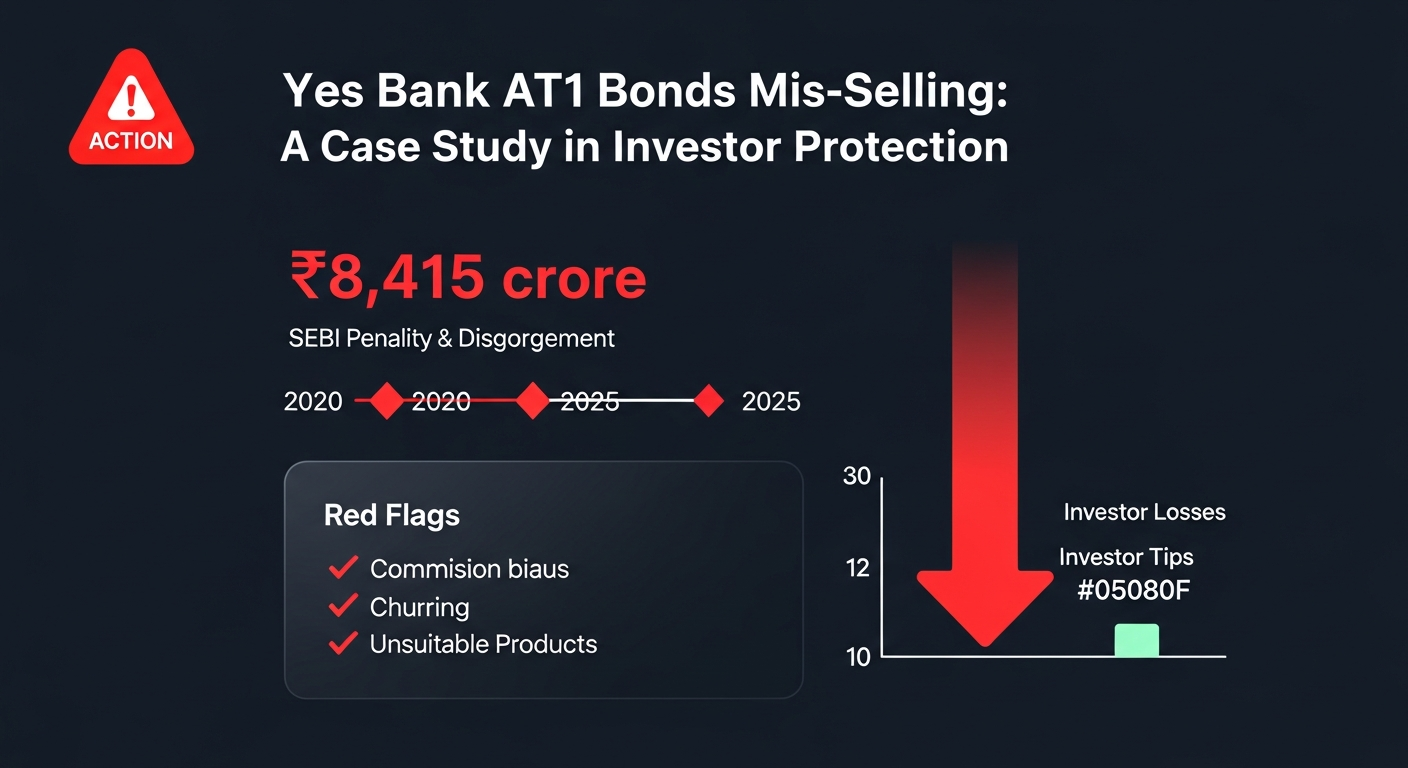
The Yes Bank Additional Tier 1 (AT1) bonds mis-selling case refers to the regulatory action taken against Yes Bank and its officials for inappropriately selling high-risk perpetual bonds to retail investors. In March 2020, as part of the bank's reconstruction scheme, ₹8,415 crore worth of AT1 bonds were fully written down, meaning investors lost their entire principal amount. This incident brought to light significant concerns about investor protection and the ethical conduct of financial product distribution. SEBI's subsequent intervention underscored the regulator's commitment to ensuring that complex financial products are sold only with full transparency and suitability assessments, a core tenet of preventing understanding misselling sebis regulatory framework.
What are Additional Tier 1 (AT1) Bonds?
Additional Tier 1 (AT1) bonds are a type of unsecured, perpetual debt instrument issued by banks to raise capital. These bonds are designed to absorb losses when a bank's capital falls below a certain threshold, as stipulated by the Reserve Bank of India (RBI) under the Basel III framework. Unlike traditional corporate bonds, AT1 bonds do not have a maturity date and carry specific clauses that allow for principal write-down or conversion into equity under defined stress scenarios. This makes them significantly riskier than conventional debt instruments or fixed deposits.
How did the mis-selling occur in the Yes Bank case?
The mis-selling in the Yes Bank AT1 bonds case primarily occurred due to a lack of adequate disclosure regarding the inherent risks of these instruments. Retail investors were allegedly led to believe that these bonds were similar to fixed deposits or senior corporate bonds, offering high interest rates with perceived safety. The critical risk of a full principal write-down was not clearly communicated, nor was the perpetual nature of the bonds. Distributors allegedly targeted investors based on their capacity for high returns without assessing their suitability for such high-risk, complex products, directly contravening SEBI's guidelines on fair practice in sales.
How Do AT1 Bonds Function and What Was the Regulatory Intervention?
AT1 bonds are structured to provide a capital buffer for banks during financial distress, making them a crucial component of the Basel III regulatory framework for capital adequacy. Their unique features, such as perpetual tenure and loss-absorption capacity, distinguish them from traditional debt. The regulatory response to the Yes Bank mis-selling specifically targeted the breaches of investor protection norms.
What is the write-down clause in AT1 bonds?
The write-down clause is a critical feature of AT1 bonds, allowing the issuer (the bank) to reduce the principal value of the bond, or even write it down to zero, if certain pre-defined trigger events occur. These events typically relate to the bank's Common Equity Tier 1 (CET1) capital falling below a specified regulatory minimum. For the Yes Bank AT1 bonds, the trigger was activated during the bank's reconstruction in March 2020, leading to the complete extinguishment of the bond's value. This mechanism is designed to recapitalise the bank, but it places the entire burden of loss on the bondholders.
What actions did SEBI take against Yes Bank and its officials?
SEBI took stringent action against Yes Bank and several of its officials for the mis-selling of AT1 bonds. In its order WTM/AB/EFD/CMD1/EFD-DRA1/67/2022-23 dated July 22, 2022, SEBI imposed monetary penalties on the bank, its former CEO Ravneet Gill, and other senior executives. The regulator found that Yes Bank had engaged in fraudulent and unfair trade practices by misrepresenting the bonds as 'super fixed deposits' and failing to disclose their high-risk nature, particularly the write-down clause, to retail investors. This action reinforced SEBI's commitment to investor protection and strict adherence to disclosure norms, consistent with principles outlined in SEBI/HO/IMD/DF2/CIR/P/2019/14 dated January 22, 2019, which mandates due diligence and fair practices by intermediaries.
Comparing AT1 Bond Risks with Traditional Debt Instruments
Understanding the fundamental differences between AT1 bonds and other debt instruments is crucial for investors. The Yes Bank case starkly highlighted how a lack of this understanding can lead to catastrophic losses. The table below illustrates key distinctions.
| Feature | AT1 Bonds (Yes Bank Case) | Traditional Corporate Bonds | Bank Fixed Deposits |
|---|---|---|---|
| Maturity | Perpetual (No fixed maturity) | Fixed (e.g., 3, 5, 10 years) | Fixed (e.g., 1, 3, 5 years) |
| Principal Risk | High – Subject to full write-down in stress events | Low to Moderate – Principal repaid at maturity (credit risk exists) | Very Low – Principal guaranteed by bank (up to ₹5 lakhs by DICGC) |
| Interest Rate | Typically higher (e.g., 9-10% pre-write-down) | Moderate (e.g., 6-8%) | Low to Moderate (e.g., 5-7%) |
| Loss Absorption | Designed to absorb losses if bank's capital falls | No specific loss absorption mechanism (except bankruptcy) | Not applicable |
| Issuer Status | Subordinated debt (lower priority than senior debt) | Senior or Subordinated debt (depends on issuance) | Senior debt / deposit liability |
| Target Investor | Institutional/Sophisticated Investors (ideally) | Retail and Institutional Investors | Retail and Institutional Investors |
How do AT1 bonds differ from conventional corporate bonds?
AT1 bonds differ significantly from conventional corporate bonds primarily in their perpetual nature and loss-absorption capacity. Corporate bonds have a defined maturity date and promise principal repayment, subject to the issuer's creditworthiness. AT1 bonds, however, are perpetual, meaning they have no fixed maturity, and critically, they include a 'write-down' clause. This clause permits the issuer to reduce or completely extinguish the principal amount if the bank faces financial distress and its capital falls below regulatory thresholds, a risk not present in standard corporate bonds.
The Financial Impact of AT1 Bond Mis-Selling: A Worked Example
To illustrate the devastating financial impact of the Yes Bank AT1 bond write-down, consider a hypothetical retail investor who was mis-sold these bonds. This example demonstrates the complete loss of invested capital due to the activation of the write-down clause.
How is the financial loss from a bond write-down calculated?
The financial loss for an investor in a bond write-down scenario is calculated by taking the initial principal invested, subtracting any interest received, and then accounting for the final value of the bond, which becomes zero upon a full write-down. This represents the net capital erosion experienced by the investor.
Free · No spam · Unsubscribe anytime
Learn investing without the jargon
Plain-English guides on MFs, SIPs, and taxes — one email a week, free forever.
Formula for Net Loss:
Net Loss = Initial Principal Invested - Total Interest Received + Final Bond Value (0)Scenario: An investor, Mr. Sharma, was persuaded to invest ₹10,000,00 in Yes Bank AT1 bonds on January 1, 2019, believing them to be a safe, high-yielding alternative to fixed deposits. The illustrative bond interest rate was 9.5% per annum. The bonds were fully written down on March 14, 2020.
Calculation of Loss:
- Initial Investment (Principal): ₹10,00,000
- Investment Period: January 1, 2019 – March 14, 2020 (approx. 14.5 months)
- Annual Interest Rate: 9.5%
- Total Interest Received: (₹10,00,000 * 9.5% / 12) * 14.5 months = ₹1,14,792 (approx.)
- Final Bond Value after Write-down: ₹0
Using the formula:
Net Loss = ₹10,00,000 - ₹1,14,792 + ₹0 = ₹8,85,208This worked example clearly demonstrates that despite receiving some interest, the investor suffered a net capital loss of ₹8,85,208, representing a substantial erosion of their initial principal. This outcome is a direct consequence of the unique risk profile of AT1 bonds, which was inadequately communicated during the mis-selling process, leading to the full write-down of principal as of March 2020. Such an event underscores the importance of thoroughly understanding the terms and risks of any investment, especially those with complex loss-absorption mechanisms.
Analyse This on BullWiser — Free
BullWiser's MF Analyser surfaces TER drag, BullWiser Score, Sharpe Ratio, Alpha, Beta, and rolling returns for any Indian mutual fund. Compare funds side by side or upload your CAS statement to diagnose your full portfolio's weighted expense load and overlap.
Open BullWiser MF Analyser →Common Misconceptions About AT1 Bonds and Investor Protection
The Yes Bank AT1 bond mis-selling case revealed several common misconceptions among retail investors regarding complex debt instruments and the scope of regulatory protection. Addressing these myths is crucial for fostering informed investment decisions.
Is it true that bank products are always safe for retail investors?
No, it is a significant misconception that all products offered by banks are inherently safe for retail investors. While bank deposits (like savings accounts and fixed deposits) are generally considered low-risk and are insured up to ₹5 lakh by the DICGC, other products such as bonds, mutual funds, insurance policies, or structured products carry varying degrees of market and credit risk. The Yes Bank AT1 bonds, despite being issued by a bank, were high-risk instruments not suitable for most retail investors. Always evaluate each product's specific risk profile, regardless of the issuer.
Does SEBI's regulation cover all aspects of bond investments?
SEBI regulates a significant portion of the Indian securities market, including the issuance and trading of corporate bonds and the conduct of intermediaries. However, the regulatory landscape for debt instruments can be complex, with different regulators overseeing different aspects. For instance, AT1 bonds, while traded in the securities market, are fundamentally a capital instrument falling under the Reserve Bank of India's (RBI) prudential norms for banks. SEBI's role primarily focuses on disclosure, fair practices, and preventing mis-selling by intermediaries, as seen in its action against Yes Bank. Investors should verify regulatory oversight for specific products, often via the AMFI portal or SEBI SCORES for complaints.
Can I rely solely on the advice of my bank relationship manager?
While bank relationship managers can provide valuable information, relying solely on their advice without independent verification can be risky, as demonstrated by mis-selling incidents. Relationship managers often have sales targets, which can sometimes create a conflict of interest. It is crucial for investors to conduct their own due diligence, clearly understand the product's terms and risks, and ensure it aligns with their financial goals and risk tolerance. Consider seeking a second opinion from a SEBI-registered investment adviser who operates under a fiduciary standard, specifically those listed on the official SEBI portal.
Frequently Asked Questions About the Yes Bank AT1 Bonds Case
What exactly happened with the Yes Bank AT1 bonds?
Yes Bank's Additional Tier 1 (AT1) bonds, worth ₹8,415 crore, were fully written down in March 2020 as part of the bank's reconstruction scheme. This resulted in a complete loss of principal for investors who held these perpetual bonds. SEBI later found that these bonds were mis-sold to retail investors without adequate disclosure of their inherent risks.
Are AT1 bonds similar to fixed deposits or regular corporate bonds?
No, AT1 bonds are fundamentally different from fixed deposits or regular corporate bonds. They are perpetual debt instruments with a unique feature: they can be written down or converted to equity under specific stress events, leading to potential loss of principal. Traditional fixed deposits and corporate bonds do not carry this principal write-down risk.
What actions did SEBI take regarding the Yes Bank AT1 bond mis-selling?
SEBI imposed monetary penalties on Yes Bank and several key individuals for mis-selling AT1 bonds to retail investors. The regulator's order WTM/AB/EFD/CMD1/EFD-DRA1/67/2022-23 dated July 22, 2022, highlighted that the bank failed to adequately explain the risks, making the sales a case of mis-selling. This action reinforces investor protection.
Who should avoid investing in AT1 bonds?
AT1 bonds are generally unsuitable for retail investors, especially those with low-to-moderate risk tolerance or short investment horizons. Their complex structure, perpetual nature, and write-down risk make them appropriate only for sophisticated institutional investors capable of assessing and absorbing such high risks. They are not for the average investor.
How can investors protect themselves from mis-selling?
Investors can protect themselves by thoroughly understanding any product before investing, asking detailed questions about risks, and ensuring the product aligns with their financial goals. Always read offer documents carefully and consider seeking advice from a SEBI-registered investment adviser. BullWiser's analyser can help you compare investment options.
Is it true that all bank-issued products are safe for investment?
No, it is not true that all bank-issued products are inherently safe. While bank deposits are generally insured, other products like certain bonds, mutual funds, or insurance-linked investments carry varying degrees of market and credit risk. Investors must differentiate between these products and understand their specific risk profiles. Always assess the individual product's risk.
Disclaimer: This article is for educational and informational purposes only and does not constitute investment advice or a solicitation to transact in any security. Mutual fund investments are subject to market risks. Past performance is not indicative of future returns. All regulatory data referenced is subject to change — verify current SEBI and AMFI guidelines on official sources. Consult a SEBI-registered investment adviser before making any financial decision.
For a complete list of SEBI-registered investment advisers, visit the official SEBI portal: SEBI Registered Investment Advisers.