Direct vs. Regular Mutual Funds: Quantifying the Expense Ratio Advantage

Direct vs. Regular Mutual Funds: Quantifying the Expense Ratio Advantage

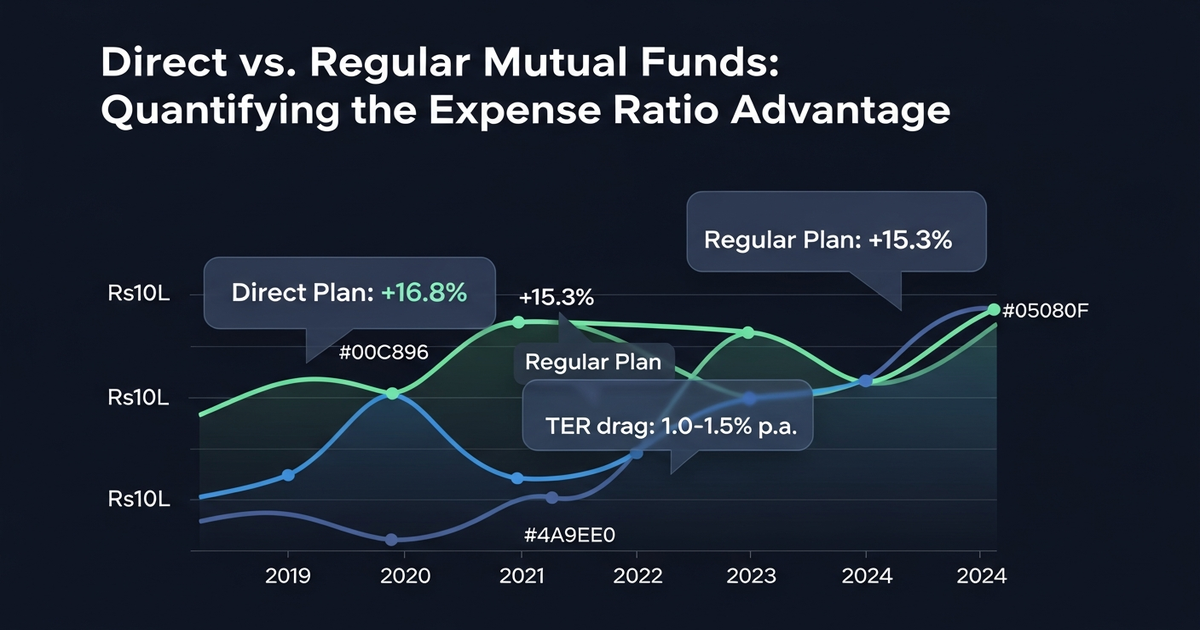
Direct mutual funds consistently outperform regular plans by 0.50-1.10% annually due to lower Total Expense Ratios (TER), a difference that compounds significantly over long investment horizons as per SEBI guidelines.

✍️ Deepak Jha··9 min read
#Direct Mutual Fund#Regular Mutual Fund#Total Expense Ratio#Expense Ratio#Investment Costs#Fund Performance

⚡ Key Takeaways

  • Direct mutual funds typically have a Total Expense Ratio (TER) that is 0.50-1.10% lower than regular plans, as distributors' commissions are excluded.
  • This TER difference, while seemingly small, can result in a corpus differential of over Rs 7.75 lakhs on a Rs 10,000 monthly SIP over 20 years, due to compounding.
  • SEBI circular SEBI/HO/IMD/DF2/CIR/P/2019/14 dated January 22, 2019, mandates transparent disclosure of TERs for both direct and regular plans.
  • The primary structural advantage of direct plans lies in avoiding distributor commissions, allowing more of the fund's gross returns to accrue to the investor.
  • Analysing fund TER and its long-term impact is critical for investors, as even minor annual cost differences can significantly alter wealth accumulation.
Direct mutual funds are generally better than regular plans because their Total Expense Ratio (TER) is 0.50-1.10% lower, as per AMFI data, due to the absence of distributor commissions. This structural difference, reinforced by SEBI circular SEBI/HO/IMD/DF2/CIR/P/2019/14 dated January 22, 2019, directly translates into higher net returns for investors over the long term.

What Is the Difference Between Direct and Regular Mutual Funds?

The primary distinction between direct and regular mutual funds lies in their distribution channel and, consequently, their Total Expense Ratio (TER). Both plans invest in the exact same underlying portfolio of securities, managed by the same fund manager, but the cost structure for investors differs significantly.

What is a Direct Plan mutual fund?

A Direct Plan mutual fund is purchased directly from the Asset Management Company (AMC) without any intermediary, such as a distributor or broker. This direct route means there are no commissions paid out to an agent, resulting in a lower Total Expense Ratio (TER) for the investor. Investors choosing a direct plan manage their own investment decisions or seek advice from a fee-based SEBI-registered investment adviser.

Free · No spam · Unsubscribe anytime

Get honest fund insights in your inbox

One email a week. No fund-house PR. No commission bias.

What is a Regular Plan mutual fund?

A Regular Plan mutual fund is purchased through an intermediary, such as a mutual fund distributor, financial advisor, or online platform that offers advisory services. These distributors earn a commission, which is embedded within the fund's Total Expense Ratio (TER), making it higher than that of a direct plan. This commission compensates the distributor for their services, includ

ShareXWhatsAppFacebookLinkedIn
✍️

Deepak Jha

Deepak Jha is the founder of BullWiser.com — India's honest mutual fund intelligence platform. An active SIP investor since 2013, he built BullWiser's scoring algorithm and writes all editorial content independently, with zero AMC or distributor affiliation.

View all articles →

Free · No spam · Unsubscribe anytime

Get honest fund insights in your inbox

One email a week. No fund-house PR. No commission bias.

📊

Free Fund Audit

Is your fund actually good?

Get the BullWiser Score, expense analysis, and benchmark comparison — free, no signup.

Analyse my fund →

Related Articles

Tags

#Direct Mutual Fund#Regular Mutual Fund#Total Expense Ratio#Expense Ratio#Investment Costs#Fund Performance