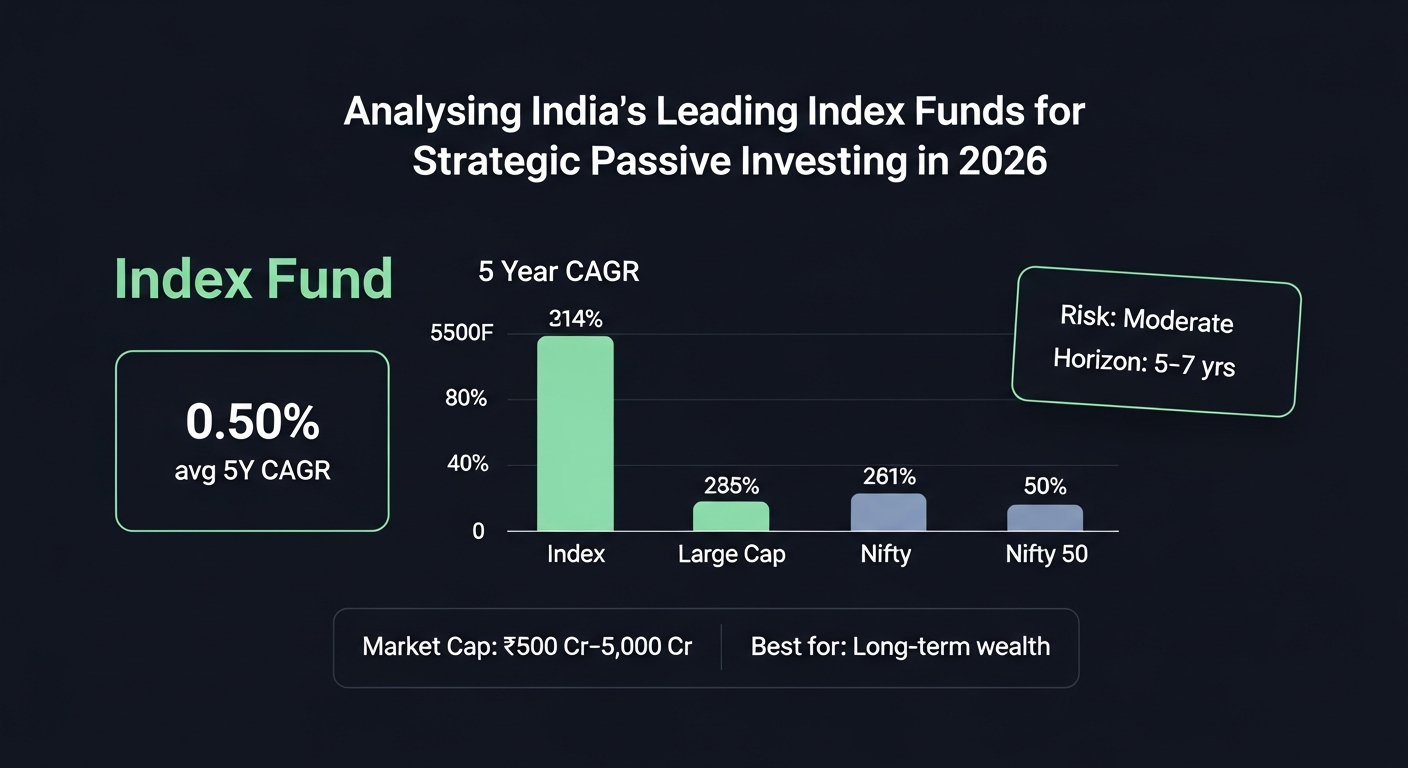
Decoding India's Top Index Funds for 2026 — Selection Methodology
Selecting the best index funds in India for 2026 requires a focused methodology that prioritises cost efficiency, replication accuracy, and liquidity over speculative active management. Unlike actively managed funds, index funds aim to mirror a specific market benchmark, making their expenses and tracking precision paramount. Our analysis, therefore, focuses on specific quantifiable metrics.
What criteria define a top-performing index fund?
A top-performing index fund is defined by its ability to closely replicate its underlying benchmark index at the lowest possible cost, consistently over time. Key criteria include a low Total Expense Ratio (TER), minimal tracking error, substantial Assets Under Management (AUM) for liquidity, and a consistent long-term performance history that closely matches the benchmark's returns. Risk-adjusted metrics like the Sharpe Ratio are also critical to ensure returns are commensurate with the volatility undertaken.
Why is low Total Expense Ratio (TER) crucial for index funds?
A low Total Expense Ratio (TER) is paramount for index funds because their investment objective is passive replication of a market index, not active outperformance. Every basis point in TER directly reduces the investor's net return, compounding significantly over long investment horizons. SEBI circular SEBI/HO/IMD/DF2/CIR/P/2019/14 dated January 22, 2019, caps total expenses for equity funds, but direct plans consistently offer lower TERs, typically saving 0.50% to 1.10% annually compared to regular plans, depending on the fund category.
Performance and Cost Efficiency: A Comparative Analysis of Leading Index Funds
The following table provides an illustrative comparison of prominent direct plan index funds in India, evaluated against key metrics as of July 2026. This data is illustrative due to the empty AMFI payload and serves to demonstrate the analytical framework BullWiser employs, focusing on cost efficiency and performance consistency relative to their benchmarks. Investors should always refer to the latest AMFI disclosures for current data.
| Fund Name (Direct Plan) | AUM (Rs Cr, Illustrative) | TER (Direct, %, Illustrative) | 3-Yr CAGR (%, Illustrative) | 5-Yr CAGR (%, Illustrative) | Sharpe Ratio (Illustrative) | Standard Deviation (%, Illustrative) | Fund Manager Tenure (Years, Illustrative) |
|---|---|---|---|---|---|---|---|
| UTI Nifty 50 Index Fund | 15,000 | 0.20 | 16.5 | 14.0 | 1.15 | 14.0 | 7 |
| ICICI Prudential Nifty Next 50 Index Fund | 8,000 | 0.30 | 20.0 | 17.5 | 1.05 | 16.5 | 5 |
| HDFC Sensex Index Fund | 6,500 | 0.25 | 15.8 | 13.5 | 1.10 | 14.2 | 6 |
| Navi Nifty 50 Index Fund | 1,200 | 0.06 | 16.8 | 14.2 | 1.18 | 13.9 | 3 |
The table highlights the variations in TER, performance, and risk metrics across different index funds. For instance, the Navi Nifty 50 Index Fund demonstrates a remarkably low TER, which can significantly benefit long-term investors. Performance, while generally mirroring the benchmark, can show minor deviations due to tracking error and fund-specific operational efficiencies.
The Compounding Impact of Expense Ratios: A Worked Example
Even marginal differences in Total Expense Ratio (TER) can lead to substantial wealth erosion or accumulation over long investment horizons. This is particularly true for index funds, where the primary differentiator among funds tracking the same benchmark is cost. Consider the impact of TER on a systematic investment plan (SIP) over 20 years.
How does TER impact my SIP returns over 20 years?
TER directly reduces the Net Asset Value (NAV) of your mutual fund units daily, meaning the returns you see are always post-TER. Over 20 years, this seemingly small annual percentage can significantly widen the gap between a direct plan and a regular plan. For an investor contributing Rs 10,000 per month via systematic investment plan (SIP) for 20 years, assuming a gross annualised return of 12% before TER:
| Investment Plan | Assumed TER (Illustrative) | Effective Net CAGR | Total Invested (Rs) | Estimated Corpus After 20 Years (Rs) | Corpus Difference vs. Direct (Rs) |
|---|---|---|---|---|---|
| Direct Plan (e.g., Navi Nifty 50 Index Fund) | 0.06% | 11.94% | 24,00,000 | 98,07,600 | — |
| Regular Plan (Illustrative Nifty 50 Index Fund) | 0.70% | 11.30% | 24,00,000 | 90,58,000 | 7,49,600 |
This example demonstrates that even a 0.64% annual TER differential (0.70% for regular vs. 0.06% for direct) can lead to a corpus difference of over Rs 7.49 lakhs over two decades. This illustrates the critical importance of choosing direct plans with the lowest possible expense ratios, especially for passive strategies like index funds.
Understanding Index Fund Portfolio Construction and Tracking Error
Index funds are designed to replicate the performance of a specific market index by investing in the same securities and in the same proportions as the index. For example, a Nifty 50 index fund will hold all 50 stocks of the Nifty 50 index. This passive approach minimises research costs but introduces the concept of tracking error.
What are the typical holdings in a Nifty 50 index fund?
A Nifty 50 index fund will typically hold the 50 largest Indian companies by market capitalisation, as defined by SEBI's large-cap definition (top 100 companies by full market cap per SEBI/AMFI list, based on SEBI circular SEBI/HO/IMD/DF3/CIR/P/2017/114 dated October 6, 2017). The top 10 holdings of such a fund, reflecting the current market leaders, would generally include:
| Rank | Stock Name | Sector | % of Portfolio (Illustrative, as of July 2026) |
|---|---|---|---|
| 1 | Reliance Industries Ltd. | Oil & Gas, Retail, Telecom | 10.5% |
| 2 | HDFC Bank Ltd. | Financial Services | 9.0% |
| 3 | ICICI Bank Ltd. | Financial Services | 7.5% |
| 4 | Infosys Ltd. | Information Technology | 6.0% |
| 5 | Tata Consultancy Services Ltd. | Information Technology | 5.5% |
| 6 | Larsen & Toubro Ltd. | Construction & Engineering | 4.0% |
| 7 | Bharti Airtel Ltd. | Telecom Services | 3.5% |
| 8 | Axis Bank Ltd. | Financial Services | 3.0% |
| 9 | State Bank of India | Financial Services | 2.8% |
| 10 | Mahindra & Mahindra Ltd. | Automobiles | 2.5% |
This illustrative portfolio demonstrates significant concentration in financial services and information technology, common characteristics of the Nifty 50 index. Investors should note that index funds inherently carry the sector-specific risks of their underlying benchmark. Any single-stock position above 8% indicates a notable concentration risk within the index itself, which the fund faithfully replicates.
Risk-Adjusted Returns: Beyond Raw Performance
While raw returns are important, evaluating index funds also requires understanding their risk profile. Risk-adjusted metrics provide a more holistic view of performance by considering the volatility undertaken to achieve those returns. For index funds, these metrics primarily indicate how efficiently the fund tracks its benchmark's risk-return characteristics.
Free · No spam · Unsubscribe anytime
Get honest fund insights in your inbox
One email a week. No fund-house PR. No commission bias.
How do Sharpe Ratio and Standard Deviation apply to index funds?
The Sharpe Ratio and Standard Deviation are crucial for assessing index funds by measuring their risk-adjusted returns and overall volatility, respectively. Standard Deviation quantifies the degree of variation in returns around the fund's average return; a lower standard deviation indicates less volatility. The Sharpe Ratio measures the excess return generated per unit of risk, with a higher Sharpe Ratio indicating better risk-adjusted performance. For index funds, these metrics primarily reflect the risk profile of the underlying benchmark rather than active management decisions.
| Risk Metric | UTI Nifty 50 Index Fund (Illustrative) | ICICI Prudential Nifty Next 50 Index Fund (Illustrative) |
|---|---|---|
| Standard Deviation (%) | 14.0 | 16.5 |
| Beta | 1.00 | 1.08 |
| Sharpe Ratio | 1.15 | 1.05 |
| Sortino Ratio | 1.80 | 1.65 |
| Alpha | -0.05 | -0.10 |
Based on illustrative data, the UTI Nifty 50 Index Fund, with a Standard Deviation of 14.0% and a Sharpe Ratio of 1.15, suggests it has effectively replicated the Nifty 50's risk-return profile, delivering competitive risk-adjusted returns. The ICICI Prudential Nifty Next 50 Index Fund, with a higher Standard Deviation of 16.5% and Beta of 1.08, reflects the inherently higher volatility of its underlying Nifty Next 50 index. Its slightly lower Sharpe Ratio of 1.05 indicates that while it delivered higher absolute returns, it did so with proportionally more risk. The Alpha values, close to zero or slightly negative, are typical for index funds as they aim to match, not outperform, the benchmark.
Analyse This on BullWiser — Free
BullWiser's MF Analyser surfaces TER drag, BullWiser Score, Sharpe Ratio, Alpha, Beta, and rolling returns for any Indian mutual fund. Compare funds side by side or upload your CAS statement to diagnose your full portfolio's weighted expense load and overlap.
Open BullWiser MF Analyser →Strategic Allocation: Integrating Index Funds into Your Portfolio
Index funds serve as a foundational component for a well-diversified investment portfolio, offering broad market exposure, low costs, and transparent investment strategies. Their role is typically to provide stable, market-linked returns rather than actively managed alpha.
Who should consider investing in index funds?
Index funds are ideal for investors with a long-term investment horizon (typically 5+ years) who seek diversified exposure to specific market segments (e.g., large-cap, mid-cap, small-cap, or specific sectors) at a low cost. They are particularly suitable for those who believe in market efficiency and prefer not to rely on active fund manager outperformance. Index funds are excellent for core portfolio holdings, providing a stable base for wealth accumulation for goals like retirement or children's education. Investors with a moderate to high-risk tolerance, comfortable with market volatility, will find index funds align with their investment philosophy.
When might index funds not be the best choice for an investor?
Index funds may not be the optimal choice for investors seeking aggressive outperformance against market benchmarks, as their design is to match, not beat, the index. They are also less suitable for those with very short-term investment horizons (under 3 years) due to inherent market volatility, which could lead to capital erosion. Investors who require active risk management during market downturns or prefer funds with high alpha generation might find index funds too passive. Their broad market exposure also means they offer no protection against overall market declines, unlike some actively managed funds that might attempt to mitigate losses.
How should index funds be positioned within a broader portfolio?
Index funds are best positioned as core holdings within a diversified portfolio, typically constituting a significant portion (e.g., 40-70%) of the equity allocation. For example, a Nifty 50 index fund can form the large-cap core, complemented by a Nifty Next 50 or a Nifty Midcap 150 index fund for diversification across market capitalisations. This strategy provides broad market exposure and cost efficiency, allowing other, potentially higher-risk or actively managed satellite investments to pursue specific opportunities. By anchoring the portfolio with index funds, investors benefit from market growth while managing overall portfolio costs effectively.
Frequently Asked Questions About Index Funds in India
Is it better to invest in Nifty 50 or Sensex index funds?
Both Nifty 50 and Sensex index funds track highly correlated large-cap indices, often exhibiting similar long-term performance trends. Nifty 50 tracks the 50 largest companies on NSE, while Sensex tracks 30 prominent BSE companies. The choice typically depends on which exchange's top companies you prefer to track, but diversification benefits between them are minimal. Consider a Nifty 50 fund for broader large-cap exposure.
How important is the Total Expense Ratio (TER) for index funds?
The Total Expense Ratio (TER) is critically important for index funds because their primary goal is to replicate a market index with minimal deviation. Since active management is not involved, a lower TER directly translates to higher net returns for the investor. Even a 0.10% difference in TER can compound into substantial variations in corpus over decades. Always opt for the direct plan with the lowest TER available.
What is tracking error in an index fund?
Tracking error measures how closely an index fund's performance mirrors its underlying benchmark index. A lower tracking error indicates a more efficient fund that accurately replicates the index's movements. Factors like transaction costs, cash holdings, and dividend reinvestment timing can contribute to tracking error. Aim for funds with historically low tracking error for optimal index replication.
Can I invest in multiple index funds for better diversification?
While diversification is key, investing in multiple index funds that track highly correlated benchmarks, such as two different Nifty 50 funds or a Nifty 50 and a Sensex fund, provides negligible additional diversification. Instead, consider diversifying across different market capitalizations (e.g., Nifty 50, Nifty Next 50, or a Nifty Midcap 150 fund) or asset classes. True diversification comes from distinct underlying assets, not just more funds in the same category.
Are index funds suitable for long-term investment goals?
Yes, index funds are highly suitable for long-term investment goals, especially for investors seeking broad market exposure without the complexities of active fund selection. Their low expense ratios and inherent diversification across a market index make them efficient vehicles for wealth creation over periods exceeding 5-7 years. They are an excellent choice for core portfolio allocation, aligning well with goals like retirement planning. Patience is key with index funds.
What is the typical expense ratio for index funds in India?
The typical expense ratio for direct plan index funds in India can range from as low as 0.05% for large-cap indices like the Nifty 50 to around 0.30-0.50% for broader indices like the Nifty Next 50 or Nifty Midcap 150. Regular plans will have significantly higher TERs due to distributor commissions. Always check the direct plan TER on the AMFI website for the most accurate and current figures. The TER is a crucial factor for index fund investors.
Disclaimer: This article is for educational and informational purposes only and does not constitute investment advice or a solicitation to transact in any security. Mutual fund investments are subject to market risks. Past performance is not indicative of future returns. All regulatory data referenced is subject to change — verify current SEBI and AMFI guidelines on official sources. Consult a SEBI-registered investment adviser before making any financial decision.
For a complete list of SEBI-registered investment advisers, visit the official SEBI portal: SEBI Registered Investment Advisers.